top of page
ELSEHERE Logo

ELSEHERE Community

公開·38 位朋友

Silent “East-Asian Tears" - STRATUM Journal

In many East Asian families, two things remain remarkably scarce.

One is the phrase “I’m sorry.” The other is tears.


They are not absent. They are simply swallowed. Tears are pushed back down the throat. Apologies are withheld before they can form. Over time, both harden into the same dull ache, a pressure that settles somewhere in the chest and stays there for years. It does not always announce itself dramatically. Most of the time, it lingers as something quieter and more difficult to name.


This is part of why family pain in East Asian contexts can be so difficult to describe. It is not always explosive. It is not always visible. It often leaves no single scene that can be cleanly pointed to as the source of injury. Instead, it accumulates through what is repeatedly denied, interrupted, or left unsaid. A feeling is dismissed. A cry is silenced. A…


18 次瀏覽

Psychology of the Uncanny


The eerie feeling when the familiar becomes strange.


Interesting Explanation:


Have you ever experienced this late at night when you're home alone? In the dim light, you catch a glimpse of that old chair in the living room—the one you've sat in for years. The shadow it casts on the wall suddenly gives you a jolt. It's still the same familiar shape, yet for a moment, it feels like a silent figure watching you. You know it's just a chair, but a nameless unease creeps into your chest.


This subtle discomfort—a blend of "familiar" and "foreign"—is at the heart of the uncanny.


4 次瀏覽

The 29th Tooth


The 29th Tooth


---We all have twenty-eight teeth.


Twenty baby teeth, twenty-eight to thirty-two permanent teeth—the numbers don't really matter. What matters is that everyone carries a fixed arrangement in their mouth. Occlusion, chewing, grinding. Day after day. Silent.


But some things don't fit into that sequence of twenty-eight.


6 次瀏覽

Do We All Have a "Mommy Complex"?


19 次瀏覽

Aesthetics of woe


12 次瀏覽
Clayton Campbell
Clayton Campbell
3月23日

This is a timely piece, perhaps because the Sakura Festivals have begun in Japan, perhaps because the world is changing in ways that are unpredictable and often violent. The mono no aware applies to the beauty of our own short lives, whose careers, impassioned concerns are swept away by inscrutable notions of time.

Why is future not here?!

Prompt Pantry | Why isn’t the future here?!


Why does it feel like the future never arrived.


Not because nothing changed, but because it arrived without ceremony.


It didn’t crash into us. It seeped in.


It became the screens we swipe, the icons we tap, the endless stream we refresh.


So clear you forget: this is already the future we once wrote about.


32 次瀏覽

Edge Lexicon| CAMP

CAMP

A style that refuses to be “proper.”


Camp loves the artificial, the exaggerated, the theatrical.

Not to escape reality, but to expose how taste gets policed, and who gets to decide what counts as “good art.”


Susan Sontag wrote that Camp is a love of the unnatural.

A devotion to artifice and exaggeration.


25 次瀏覽

Kohei Sugiura ‘Zen Uchu Shi’ (1979) Prompt Pantry | Odds & Ends

A book can hide a galaxy in its edge.


Published in 1979, Kohei Sugiura’s Zen Uchu Shi (Summa Cosmographica) turns star charts, data, and text into a reading environment. It does not simply visualize information. It reprograms how the eye moves: density becomes navigation, overprinting becomes time, and the page becomes a field you cross rather than a surface you consume.


5 次瀏覽

Why are goldfish beautiful, yet unsettling?

Why do goldfish so often make us uneasy?

They are undeniably beautiful, yet their beauty can feel manufactured.

They live inside transparent containers, as if they are allowed to exist, and also permanently watched.


In this issue, we use the goldfish as a way to ask a few questions:

What kinds of meaning have humans projected onto goldfish?

Why do they so often carry a dreamlike, specimen-like, even corpse-like feeling?


10 次瀏覽

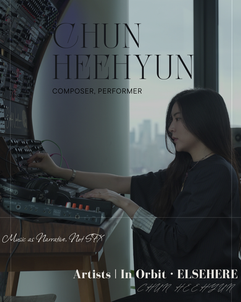
CHUN HEEHYUN | ELSEHERE Artists | In Orbit

CHUN HEEHYUN is a composer and performer who treats music as narrative. Her soundscapes do not accompany the image. They lead it, shaping time, space, and emotional structure.


Working through modular synthesis and Eurorack systems, alongside MIDI orchestration that re-voices Western instruments toward the timbral memory of gayageum, haegeum, and janggu, she builds a listening field where texture becomes cinematic language.


This feature is part of Artists | In Orbit, ELSEHERE’s slow thread for staying with practices in formation.


For artists and researchers: submissions are open via ELSEHERE Open Call in bio.

We archive and stay with artists and practices that keep advancing in method and aesthetics. If you are building your own thread, we welcome your submission into our editorial and curatorial field.


14 次瀏覽
Clayton Campbell
Clayton Campbell
2月19日

Are there links to your work in this post or am I just missing them. It would be great to hear/see your work. Please let me know, thank you for posting.

Edge Lexicon | Algorithmic Aesthetids

How do finite rules generate infinite forms?

In this issue, we trace the aesthetic logic of digital structures, from information aesthetics to contemporary generative practice, and ask how algorithms produce and embody value at the edge of order and randomness.


Our focus is not technique for its own sake, but critical framing:

When creation becomes procedural, what shifts in artistic subjectivity and originality?

Is the machine merely executing rules, or participating in creation?


Keywords: generative art | fractals | algorithmic music | AI-generated content


16 次瀏覽

Edge Lexicon | Hauntology

10 次瀏覽

Prompt Pantry|Odds & Ends - Tree of Codes

10 次瀏覽

Edge Lexicon- Social Darwinism

We believe the sharpest words do not simply describe the world. They reconfigure how we see, and what questions we dare to ask.


6 次瀏覽
    bottom of page