


I AM YOU, TOO: Perception, Prejudice, and the Fragile Work of Seeing

Benoit Béal, By_33
Artist: Benoit Béal, working as By_33
Location: Saint-Bonnet-les-Oules, France
Project: I AM YOU, TOO
Year: 2025
Medium: Acrylic painting on linen canvas
Dimensions: 60 × 60 cm
Disciplines: Visual art, design, painting, installation, photography, video

A simple image, a difficult proposition
At first, I AM YOU, TOO appears almost blunt in its visual construction. Black and white. Text and ground. A sentence held inside contrast. The work does not hide its mechanism or ask the viewer to decode a private symbolic system. It places perception in front of us and asks a direct question: what do you think you are seeing?
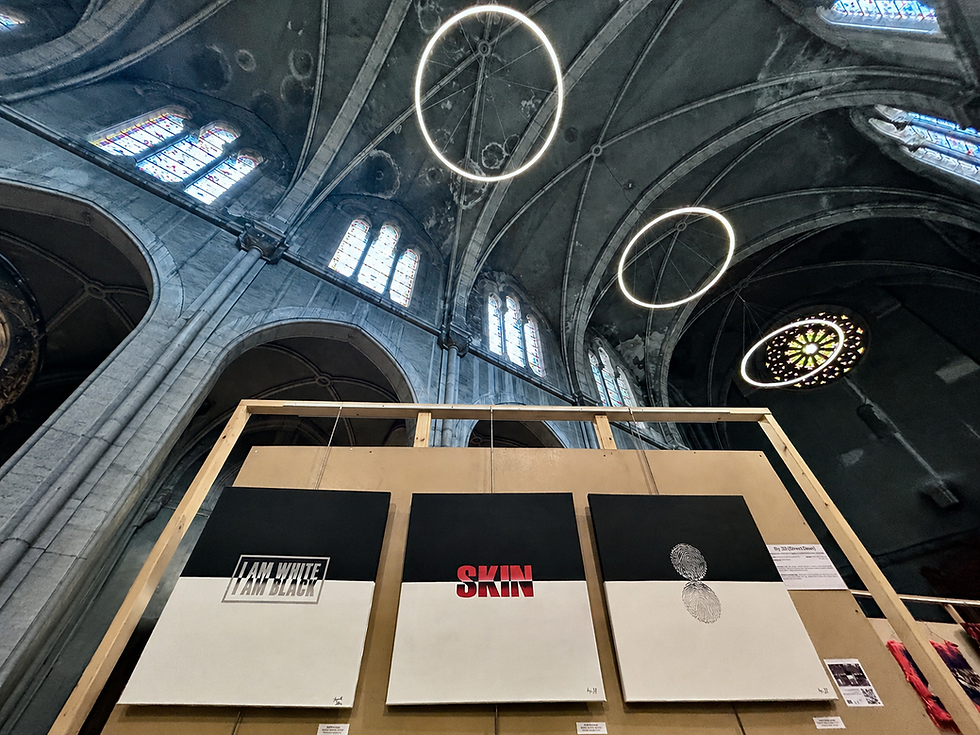
The project, developed by French designer and multidisciplinary artist Benoit Béal, working under the name By_33, begins with an optical structure. In I AM YOU, TOO: Same Grays, the words “I AM WHITE” and “I AM BLACK” seem to carry different tonal values. One appears lighter, the other darker. The surrounding fields push the eye toward a quick conclusion. Yet the gray values are designed to be identical. Difference appears where the eye has already been trained to expect it.
That visual shift gives the project its force. Béal uses illusion as a way to speak about prejudice without turning prejudice into a flat moral lesson. The viewer is not simply told that perception can be wrong. The viewer experiences the error inside the act of looking. The work turns the eye into evidence.

False seeing
Béal describes the project as rooted in “false seeing,” or faux voir. The phrase is useful because it names something more unstable than a simple visual trick. False seeing is not merely a mistake. It is a learned confidence in the mistake. We believe we are seeing directly, while perception has already been organized by context, contrast, expectation, memory, and social conditioning.
This is where I AM YOU, TOO becomes more than an optical exercise. The work asks how quickly perception becomes judgment. It asks how a visual difference, once framed by language and social history, can harden into a belief about identity. The black field and white field are minimal, almost severe. The text sits between them like a pressure point. In that narrow space, the eye performs a familiar social reflex: it separates, assigns, and confirms.
The project’s quietness matters. Béal does not build the work through spectacle or accusation. He creates a stripped visual situation in which certainty becomes unreliable. The viewer is asked to remain with the discomfort of misrecognition. What felt obvious a moment earlier begins to weaken.
Context is never neutral
The strongest idea in I AM YOU, TOO is that perception never arrives alone. What we see is always held by a surrounding field. In optical illusion, that field may be a gradient, shadow, surface, or spatial relation. In social life, it may be family history, media representation, inherited fear, racial coding, national memory, or the repeated images through which a culture teaches people to read one another.
Béal’s use of Adelson’s illusion is precise for this reason. The illusion shows that the eye does not measure value in isolation. It reads through relation. Light, shadow, and placement alter what appears to be true. In the artist’s hands, this perceptual fact becomes a humanistic proposition: if visual judgment is so easily shaped by context, social judgment must be handled with greater care.
The ethical force of the project begins here. I AM YOU, TOO does not ask the viewer to deny difference. It asks the viewer to notice the conditions under which difference becomes hierarchy, suspicion, distance, or fear. Its antiracist meaning emerges from this shift. It does not preach sameness as a slogan. It makes sameness appear through a visual event, then asks why the viewer did not see it at first.

The mark of the individual
In I AM YOU, TOO: Unique Fingerprints, Béal moves from tonal illusion to the fingerprint. The motif introduces another layer of the project’s thinking. A fingerprint is one of the most familiar signs of singularity. It marks the person as distinct, traceable, and unrepeatable. It belongs to the legal record, the body, the archive, and the scene of identification.
Yet here the fingerprint is placed inside the same stark compositional world. Black and white still divide the field. Reflection and reversal remain active. The fingerprint becomes both a sign of difference and a sign of shared human form. No two fingerprints are identical, yet every fingerprint belongs to the same bodily fact: the human hand, the human surface, the human trace.
This tension gives the series a more nuanced register. Béal is not dissolving individuality into a universal claim. He is asking how individuality can remain visible without becoming the basis for exclusion. Difference, in this work, does not need to be erased in order for shared humanity to be recognized.

Blood, skin, and the visible surface
I AM YOU, TOO: Same Blood brings the language of the body closer to the surface. The word “SKIN” appears in red, held between black and white fields. It is a direct image, almost severe in its economy. Skin is the first thing read by others, yet it is also the surface on which history has placed enormous weight. The work compresses that violence into a single word.
Béal’s statement for the project returns to the idea that beneath visible difference there is a shared human foundation. The phrase “our blood is red” is deliberately simple. In the work, that simplicity becomes a visual pressure. The red of blood cuts through the black and white system. It interrupts the binary. It reminds the viewer that the social reading of skin has often overwhelmed the biological and emotional continuity of human life.
The project is also informed by the emotional resonance of the Black Lives Matter movement, as well as by the artist’s own multicultural family background and experience across different cultures. Béal does not reproduce the language of protest directly. He works at the level of perception, asking how prejudice begins before it becomes speech, before it becomes policy, before it becomes violence.
From design to ethical perception
Béal’s broader practice helps explain the clarity of the project’s form. Coming from design, spatial thinking, object culture, visual communication, and self-directed artistic experimentation, he approaches the image as a constructed environment. His design background gives the work its economy: every element has a function, and the viewer’s eye is guided through contrast, proportion, legibility, and interruption.
At the same time, I AM YOU, TOO resists the neutrality often associated with design language. It uses design’s precision to approach a moral problem. The question is not simply how to make an image effective. The deeper question is how an image can expose the instability of perception, then convert that instability into empathy.
Béal was born in Saint-Étienne, France, and is based in Saint-Bonnet-les-Oules. His practice has been shaped by travel, multicultural encounters, and a long-standing interest in the relationship between humanity, objects, machines, ethics, and visual language. His references move across design, architecture, photography, cinema, sculpture, music, and contemporary art. In I AM YOU, TOO, those influences are reduced into a concentrated visual field: a square canvas, a few words, a perceptual trap, and a human claim.

To understand is to see
Béal’s one-sentence blurb for the project reads: “To love is to understand. To understand is to see.” In another context, such a sentence could risk becoming sentimental. Here, it works more sharply because the project has already complicated the act of seeing. To see, in this body of work, is not the same as looking. Looking can remain automatic. Seeing requires the suspension of certainty.
This is why I AM YOU, TOO is strongest when understood as a project about perception before it is understood as a message about unity. Its humanism is not decorative. It depends on a visual test. The viewer must recognize that what seemed immediate was mediated, that what seemed evident was structured, that what seemed different may have been produced by context.
The work leaves us with a modest but difficult demand: before judgment becomes belief, before belief becomes distance, before distance becomes prejudice, look again.
About the Artist

Benoit Béal, working under the name By_33, is a French designer and multidisciplinary artist based in Saint-Bonnet-les-Oules, France. His practice bridges visual art, design, spatial thinking, object culture, photography, installation, and music. Shaped by travel, multicultural encounters, and a self-directed creative path, Béal explores illusion, perception, identity, and the social structures that shape human relationships. His work combines minimalist visual language with emotional and symbolic inquiry, often using contrast, abstraction, and perceptual instability to question prejudice, conditioned reflexes, and the fragile ways people learn to see one another.
Socials
Project Credits
I AM YOU, TOO is a project by Benoit Béal, working as By_33.
Painting: By_33, Benoit BéalPhotography: Benoit BéalVideo images and production: Benoit Béal and Eden BéalMusic: Benoit Béal
Artist website: benoitbeal.comInstagram: @design_by33_



Comments