


From the Roots to What You See | Inside Out: A Conversation with Noa Covelo

Updated: May 7
History isn’t only archived in museums or written in books. It lives in choices, in bodies, in what we keep and what we hide. Here, we speak with artists slowly, and we look at works carefully. In this room, we listen for the turning points that shaped an artist, and we look for the blind zones that shape a work. Inside Out brings the unseen into view. Today, we are joined by Noa. To begin, let’s have Noa introduce themselves.
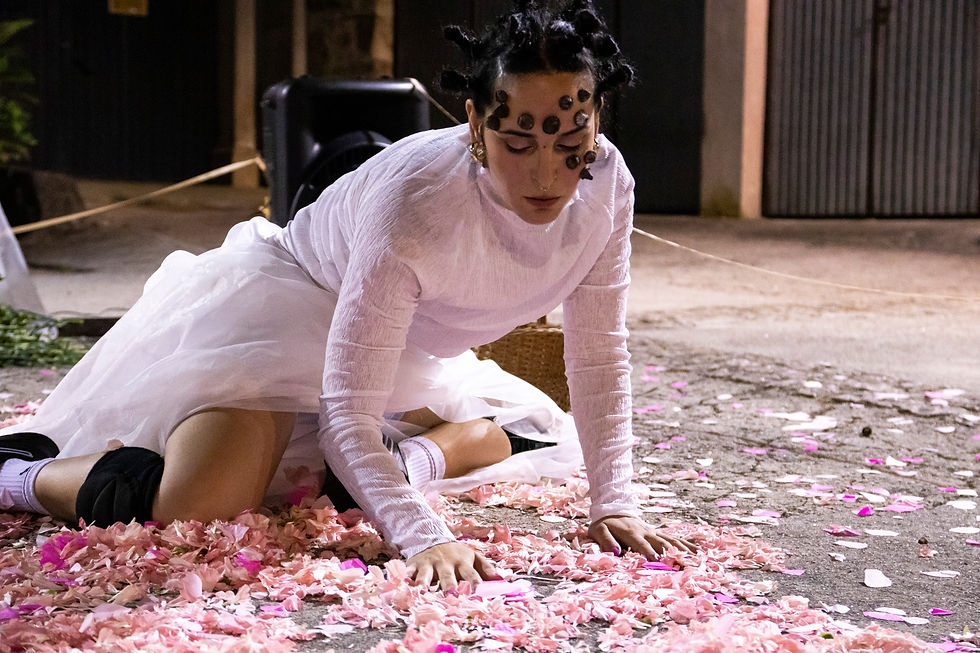
Noa Covelo: Hi, thank you for having me. My name is Noa Covelo. I’m a performer, a dancer, and a theater maker. I have worked in community-based contexts as well as in the creation of contemporary pieces through dance, theatrical language, and performance. My practice moves somewhere between the performing arts, the visual arts, and sound production. What interests me most is the development of new languages.
That feels very close to what we care about. If this is not simply an interview, but a record that will remain, what do you hope people carry with them after today?
Noa Covelo: I always want to share that every body matters, and that movement belongs to everyone. Expression through the body is for every single person, for every human being. I would like to invite people to move, and to enjoy being present through movement.
Valkyrie Yao: That is really moving to hear. In our own understanding, we often think that human beings moved first, danced first, before they learned how to voice things, how to speak, how to exchange information through sound. So in that sense, movement comes before speech. It means a great deal to hear you begin there.
Let’s begin with the moment that shaped your way of seeing the world. What do you want this conversation to make possible that a standard interview usually does not?
Noa Covelo: I would like this to be a conversation about the body, about community, and about space. I want to think a little more about how we can change space, and how space can change us.
Valkyrie Yao: Before we talk about the work, I want to find the person who existed before the work, before you had a name for what you were doing. Looking back, was there a moment that quietly changed how you see the world? In that moment, what did you learn, and what did you lose? It could be something very early.
Noa Covelo: For me, I always return to one very special moment, something that everyone experiences, but that becomes particular once you really realize what it is. It is the day, or the minute, or the second when you understand that there is a voice inside you that nobody else can hear. Your thoughts.
For me, that moment is the root of everything. It has to do with inner space and outer space, with realizing that there is something happening inside you that belongs only to you. I think that awareness is very important. It is one of those moments I keep very clearly in my memory. I still think, wow, I remember that day.
Valkyrie Yao: Yes. Sometimes something happens in the past, and we carry it in the body without fully knowing it. Then much later, when we begin doing something, it suddenly returns, and we realize it was already living there.
If that specific period of your life were a chapter in your personal history, what would you call it?
Noa Covelo: I like that movement theme of inner and outer, so maybe I would call it The Inner-Outer Conversation.
Valkyrie Yao: So in a way, you feel there was always another part of you standing beside you, or within you, something inward that stayed present?
Noa Covelo: Yes. When I think about my childhood, I remember being very shy. Other people described me as responsible and mature, but really I was just very shy. I was not mature, and I was not especially responsible. I was simply quiet, observing everything and not saying much.
So I think a lot about the difference between how everybody saw me and how I might change the way people saw me, while still protecting that inward part of myself, that shy part. I could change outwardly, but inside I was still that shy person.
Valkyrie Yao: Around what age was that?
Noa Covelo: Probably when I was around eight years old.
Valkyrie Yao: That’s very young. So even then, you already felt that you wanted people to see you in a certain way, beyond their assumptions.
Noa Covelo: Yes. That was also the moment when I started taking theater classes, so it is very close in my mind to artistic practice. I think that is why I bring it up here. It was my first time doing drama classes and entering that kind of expressive space.
Valkyrie Yao: Do you remember anything specific that happened then, some situation, some response, some moment with classmates or teachers, that made you feel this way? Because that desire, to be seen beyond assumptions, is already a very developed feeling for someone so young.
Noa Covelo: I’m not completely sure, but maybe it had to do with feedback. Maybe it was the first time I understood what feedback meant. Doing something in class that other people liked, and then receiving a response. That may have been the first moment when I felt that expression could show something to others, and that others could discover something about me that even I did not know yet.
It was a very honest and vulnerable moment with someone else, maybe with an audience, maybe with classmates, maybe simply with the people who were there. I think it surprised me a lot. Talking about it now, I really feel like I’m traveling back to that moment.
Valkyrie Yao: What I’m hearing is that you already had a strong awareness of your surroundings, and of other people’s responses. You could sense people quickly, and you were very sensitive to the environment around you. Do you think that is something you have carried for a long time, maybe even a kind of artistic quality that was already there before you knew how to name it?
Noa Covelo: Yes, but it was something I never really considered a quality for an artist. I don’t know if you had a similar experience, but when you don’t come from an art context, people often imagine performers as expressive, expansive, spontaneous people. I was not that kind of artist, or that kind of person.
So for a long time, I never thought that self-awareness could actually help my art. It was maybe only two years ago, when I discovered somatic dance and somatic movement, that I realized this was actually something important. I understood that what is already natural in you can become part of what makes you distinct as an artist. Self-awareness, observing yourself, sensing others, all of that matters deeply.
Valkyrie Yao: Let’s stay with those early memories a little longer. What is the earliest memory you have of really looking at something, not just seeing it? It doesn’t have to be art. It could be a face, a room, a stranger, or even a quality of light.
Noa Covelo: Right now, what comes to me is actually the smell of kindergarten, when I was maybe two years old, or something like that.
Valkyrie Yao: That’s very interesting. When you said that, I immediately thought of my own kindergarten too. They were always cleaning the floors with very strong products because they wanted to keep the children safe, so that smell is also very strong in my own memory.
What do you think stayed in that memory for you? Why do you think that smell remained so clearly?
Noa Covelo: I feel that maybe it was the first time in my life that I was in a place where everything was new. I did not know what was going to happen. I did not know what was going on. I did not know who the people were, or what the space really was. So maybe it was the first moment of feeling completely lost.
Valkyrie Yao: So maybe that was the first time you consciously felt, I am lost.
Noa Covelo: Maybe, yes.
Valkyrie Yao: Let’s stay with that for a little while. Growing up a bit more, was there something, a person, a rule, an atmosphere, that quietly defined what you were not supposed to notice?
Noa Covelo: Right now my mind is still very much in that kindergarten moment, and I want to stay there because maybe it is the first time I have spoken about this clearly. In my region, we have both Spanish and Galician. So maybe one of the first things was hearing teachers speaking in Galician, or speaking in another language, and feeling that my brain had to adapt in order to understand.
Nobody tells you, when you are that young, that language exists as a system. You are just so little. But maybe that was one of the first times I felt that there was something operating around me that I did not yet know how to grasp.
Valkyrie Yao: That’s actually very beautiful, because as children we often don’t yet understand distinctions like nation, city, language, or border. We move through the world before those systems become clear.
Let’s move a little further. Was there a moment when you felt there were two lives in front of you, two roads, and you chose the one that was harder to explain to other people?
Noa Covelo: Yes. The first thing that comes to mind is every time I moved. Every time I changed houses, or moved because I was a student, or later because I started working. Even during college, I changed homes many times, maybe once every year or every two years.
Those adult decisions, where to live, who to live with, what kind of life to build, were always hard for me, because you never really know what is better, or what will make you happier. I always felt that each move involved asking myself whether I should stay where I was or try something different, something that might improve my life, give me new opportunities, or open new experiences. Those decisions are still difficult for me.
Valkyrie Yao: That is something many artists feel very strongly, especially artists who live across borders or move between different contexts. They leave one country, move to another place, and change their whole life through that decision. What was the context that made you think, I am going to choose a new life. I am going to move somewhere else?
Noa Covelo: In Europe, we have exchange and internship programs that allow us to continue our education in another country. For me, the path through education and becoming an artist was always very structured. I wanted to do the four years. I wanted to live through the full experience of the school.
Then, when I had the chance to move, I chose Lisbon because it was close enough, but still another country. I felt it was time to open the wall a little and try a different experience. The idea of expanding my mind has always been a very strong impulse for me. That was a big part of what pushed me to leave.
Valkyrie Yao: After you moved, was there a specific journey that felt especially hard? Was there ever a moment when you wanted to give up?
Noa Covelo: Yes. I remember when I had been in New York for about six months. I had arrived for a program, and I started to feel that I was not really achieving the kind of growth or improvement I had imagined for myself. I thought, I want to leave this. I do not want to keep going. It feels too far away.
But what made me stay, what made me keep going, was probably the thought that this was temporary, and that I needed to finish it. I also tried to find support in things that were outside what was difficult. If something felt dense, I tried to find another kind of learning within it. For example, maybe I would take a dancehall class because I had never danced dancehall before. Finding new learning made me stronger. It helped me think, okay, I want to be here, and I want to finish this.
There was also something important in the idea of closing the circle. Reaching the end of the path first, and then deciding what it all meant.
Valkyrie Yao: So even though it was hard, you wanted to complete the path before judging it. You wanted to bring it to an end first.
I want to go back for a moment to what you said about language. We both know English is not our native language. For artists, learning another language is not just about vocabulary. It also changes the structure of the mind, the way we think and communicate. When you arrived in the United States and started living and working in New York, using English every day, what did that feel like for you? And do you think that shift became a source of inspiration for your work?
Noa Covelo: Yes, I think so. Because when you do not have the full spectrum of words, especially when you want to describe something very precisely, or when you want to speak in a particular tone, or be especially polite or nuanced, you realize that language has many subtle shadows that are difficult to access immediately.
At first, I accepted that limitation. I thought, okay, I do not yet have my full vocabulary to express myself. So I started giving more through energy, gesture, smiles, and by listening more carefully. That became something I carried into my work, but also into life. It taught me to listen more, to pay more attention, and to give more importance to the body and to energy.

In that sense, being in another country with another language made me value listening in a deeper way. And I think that did influence my work.
Valkyrie Yao: Yes. Living in a different cultural environment gives us different information, different sensations, different forms of stimulation. That really matters for artists.
I want to ask you now about a turning point in another sense. Is there one specific event, one experience, that remains unforgettable to you?
Noa Covelo: I was trying to find something positive and beautiful, but the first thing that comes to me is not that. The first unforgettable thing I think of is the first time I had a panic attack.
It is unforgettable because of the way my entire system changed on its own, how everything inside me went into upheaval. I do not think I will ever forget that first time. It is a very strong experience, and also one that has to do with perception. It is quite common too, so I think it is good to normalize it. It happens. It is painful and uncomfortable, but it happens.
Valkyrie Yao: Do you think that event is still present in your work today? Not necessarily as subject matter, but maybe as a rhythm, a reflex, an intensity, something that appears in your practice.
Noa Covelo: Yes, definitely. As an audience member, what I really enjoy seeing in other artists’ works is when there is some force that comes from something very deep, something tense. For me, there is always a kind of boundary in expression, something very intense, maybe even animal, if I can say that, or savage.
I am always looking for that in a small moment, or in a theme, or in an impulse. I think of it as the risk point of the piece, the place where art becomes risky. I like to have that in my own work too.
Valkyrie Yao: So in a way, you build a risk point into your work because you have known that intensity in life.
What would you say you have inherited aesthetically without consciously choosing it?
Noa Covelo: I think I am always trying to look toward what is at the edge, what society is not really looking at. Because I think a great deal about community, and about what I want to share.
In my work, I often feel that what I want to do is open a small window so people can see what nobody wants to look at. Usually those are the strange things, or the things that society pushes to the edges, the things nobody really cares about. That moves me a great deal, and I think it is one of the themes that keeps returning in my work.

Valkyrie Yao: Is there someone from that earlier time, not a mentor or a major figure, just someone you encountered once and never again, who said or did something that has stayed with you?
Noa Covelo: I think I can answer that through movement and art. I remember artists I admired who taught us that movement vocabulary carries meaning in every aspect of human life. That you can think about politics through movement, through inner and outer space, through tension, through time.
That relationship impacted me a great deal. The realization that movement is not separate from thought, or from politics, or from life, but can carry all of those things.
Valkyrie Yao: Let’s move now to the work itself. This may be the simplest question, but also one of the hardest. Why do you make art?
Noa Covelo: I need a second to think.
I think art is the way I understand my life experience. For me, art is deeply connected to creativity, and creativity is something essential to being human. It is one of the things that gives meaning to life.
Whenever I am doing another kind of work that is not related to art, I can understand that it is important and necessary. But for me, the thing I most need, in order to give and to receive, is art. I think it is how I understand human relationships.
And I feel that art is connected to everything. It is connected to how we see the world, to communication, to science. It is a huge field. I feel very motivated by it because it is so vast.
Valkyrie Yao: What kind of responsibility do you think you carry as an artist?
Noa Covelo: For me, personally, it is connected to the idea that art is democratic.
Valkyrie Yao: Could you tell us more about that?
Noa Covelo: Yes. I have heard many people say things like, “I don’t understand art,” or “I can’t dance,” or “I would love to dance, but I can’t,” or “I would love to be an actress, but I don’t have this, or I don’t have that,” or “I am too old,” or “I am too young,” or “I live in a village where there is nobody to teach me.”
So for me, this idea matters a great deal. I believe everybody can do everything in some form. I do not think art is something you have to understand in some rarefied way, and I do not think dance belongs only to a few people.

I remember when I was younger, seeing a teacher working with people in wheelchairs, or with people who had very different kinds of mobility, and she was asking, okay, what is the exercise for them to dance? Even if the dance is only in the hands, then what beautiful dance happens in the hands? Sometimes it might even happen in the eyes.
That changed something for me. It made me feel that across the whole spectrum of movement, everybody can move, everybody can dance, everybody can participate in expression. That matters to me deeply, both as an artist and as a person.
Valkyrie Yao: During the process of creating a new work, what carries the most pressure from outside the work itself: institutions, audience expectations, funding, identity, or context?
Noa Covelo: I think maybe the audience.
Valkyrie Yao: The audience gives you the most pressure?
Noa Covelo: Yes. Because in the end, that is the communication I am trying to bring onto the stage. So it affects the process very strongly for me.
Valkyrie Yao: When you are creating, are you already thinking about the audience and their expectations, or does that only come later, after the show?
Noa Covelo: I try to worry about that very late in the process, maybe three days before the show. When you create something and then invite people to see it before the audience comes, that is very important for me.
Sometimes I am both directing and performing, which means I am also inside the work physically. So there can be moments when the expectations created by the piece are not yet arriving where I want them to arrive.
At that stage, I like to hear what the audience thinks. I can make changes, of course. But I respect the process, and I respect the piece, even if the feedback is painful, or even if I do not like it. I still trust the work because I understand the process that produced it.
Valkyrie Yao: As an artist, what do you care about most as a source of learning? What kind of information do you return to in order to keep growing and create the next work?
Noa Covelo: Right now, because my work has changed a great deal, and because I am very focused on solo practice at the moment, I am paying much more attention to the visual.
That also makes sense because of the way everything now moves through screens, through video, through photography, through visual circulation. I am taking much more care with visuals, and also because I have started working with visual artists very early in the creative process, thinking about color, texture, and this more material side of the work.
So right now, at this point in my career, I would say the visual is the strongest source of growth for me.

Valkyrie Yao: When do you most often have to explain yourself as an artist? And when you do, does that make you feel freer, or more suffocated?
Noa Covelo: I actually like talking about my work a lot. It depends very much on how the person is listening. I can feel that very quickly, and sometimes I change the way I speak because of it.
If someone does not care at all and is just asking, “What are you doing?” then I think, okay, let me explain this in a simpler way and not go too deeply into my thoughts and ideas.
Even in a more superficial or accessible explanation, I still try to be honest, and to bring in something new. Because for me, being an artist, and even being queer in this society, is already a specific position in history. We are living in a time when art is often reduced to aesthetics, to marketing, to what looks nice. So even in a simpler explanation, I still want to introduce something that unsettles the stable perspective a little, that opens another universe.
So yes, I like talking. But for me, it depends on whether the person is really listening.
Valkyrie Yao: I understand that very much. Sometimes within an artist community, you can speak openly and deeply. But outside of that, especially in institutions or adjacent industries, people often already have assumptions about what an artist is before you even begin speaking. And then you find yourself having to explain your existence in order to access resources, support, or opportunities.
We have covered a great deal today. We talked about your personal history, why you make art, your responsibility as an artist, and also about difficult experiences in your life that shaped your practice. Before we close, I want to ask: are you okay? How do you feel right now?
Noa Covelo: Right now I feel very grateful. I am always grateful to talk about art and life with my community. Thank you so much for your questions, and for giving me this opportunity to speak.
I feel very listened to. Returning again to this idea of inner and outer, I really feel this conversation as something happening inside that is also moving outward. So yes, I feel very grateful.
Valkyrie Yao: We really believe that before artists are artists, they are human beings. That is why we wanted to begin with your personal history, and with you as a person, not only with art itself. That earlier part of life quietly shapes the way one later becomes an artist. So we are very glad to have had this conversation with you today, and to hear about your inner and outer worlds.
Let me ask the final question. If this episode had a title, what would you call it?
Noa Covelo: I would say: From the Roots to What You See.
Valkyrie Yao: From the Roots to What You See. That already carries so much inside it.
Let me ask one last thing. Where do you see yourself in the next five years?
Noa Covelo: I see myself deeply connected with community, with people of different ages and different backgrounds. I see people connecting through a shared interest in art and movement.
I see myself belonging to something like that. I see myself in peace, and in sharing, through the arts, through conversations, and through dreaming another world out of our current context.
Valkyrie Yao: And after one hundred years, if there were only one sentence from you, one sentence from your work, your philosophy, your way of being, that you would want people to remember, what would it be?
Noa Covelo: Your body is your temple.
Valkyrie Yao: I love that. It carries so much inside it.
We are grateful for this time together. Before we finish, is there anything you want to say to our audience?
Noa Covelo: Yes. Let’s connect.
Valkyrie Yao: Let’s connect. Thank you to Noa for joining our Inside Out series today. We’ll see you next time.
Noa Covelo's Works
About Noa Covelo

Noa Covelo is a dancer, theater-maker, and choreographer whose work expands across performance, pedagogy, and research. Originally from Spain, she holds a BA in Physical Theater (ESADG) and is certified as a Movement Analyst through the Laban/Bartenieff Institute of Movement Studies in New York, where she was awarded a Fulbright Fellowship in 2024.
With more than seven years of teaching experience in schools, community programs, and higher education, Noa’s pedagogical approach emphasizes embodiment, creativity, and the transformative potential of performance. She has directed and produced stage works with young performers—including Rocky Horror Picture Show, OZ, and Amanece que no es poco—highlighting her commitment to collaborative, process-driven creation.
As a performer and choreographer, Noa develops original works that weave physical theater, contemporary dance, and somatic awareness. Her recent solo Ritual of Resignation premiered at FRIGID New York, blending urban electronic soundscapes with movement vocabularies inspired by dirty realism and ritual practice. In 2025 she created CORPOFLOR, a movement and sound piece born from her artistic residency at ARTISTEA, where she explored the intersection of organic landscapes, corporeality, and memory through live performance.
Currently based between Brooklyn and Spain, Noa continues to create, teach, and perform internationally, driven by a curiosity about how the body holds memory, community, and the possibility of transformation.


Comments