


Mercurius and the Psychology of an Art Project
Art practice as a Process of Self-transformation
Introduction
This essay explores how art practice functions as a process of self-transformation, framed through alchemical and psychological archetypes. Drawing on the project Self in Flux (2025), I examine how artistic work through material experimentation, reflective writing, and philosophical inquiry converge to form a methodology of transformation. Guided by thinkers such as C. G. Jung, Rudolf Steiner, and Gaston Bachelard, I argue that art practice can serve as a disciplined activity for exploring psychic dynamics and achieving the unification of opposites.
While the Jungian concept of Persona serves as the primary foundation for my artistic research, the works of Steiner and Bachelard have been essential companions in the background. I have highlighted these thinkers alongside Jung because their theories resonate deeply with one another. This essay follows a line of inquiry that builds on studio practice, the concept of the "axis" as a creative field rather than a symbol, and curation as an extension of art practice.
Self in Flux: Multidisciplinary Practice
In August 2025, I initiated a project titled Self in Flux. I conceived and conducted this project independently, working across various media and materials, ranging from drawing, painting, and sculpture to video installations, mixed media, and experimentation with soil, straw, resin, coffee bags, limestone, sand, and powdered aggregates. These distinct mediums coexisted within a shared thematic investigation, moving toward a synthesis of textual reflection and philosophical study. This multidisciplinary approach was essential in creating a body of work that renders the complexity of the inner world and its transforming nature visible. I could not do otherwise but work to organise and bring the nature of each material to a unified artistic production and experimental endeavour. It is my conviction that in this way, psychic complexity can be resolved into a visible form.
For some years now, I have been drawn to the hidden nature of the human being as the most influential force in our existence – a sentiment echoed in Jung's works. Guided by his work on the collective unconscious, alongside the writings of Rudolf Steiner and Gaston Bachelard – who explored spiritual and psychic dimensions – I have since integrated these inquiries into my art practice. This essay traces the awakening of an inner mechanism, demonstrating how art practice functions as an activity of self-transformation.
Self-transformation is unavoidable, though its full state cannot be achieved at once. This nature of the human psyche reveals a continuous state of flux; no matter how much one may consciously resist it, transformation runs without consent. It is intrinsic to the nature of being. The process becomes clearer when one understands that old beliefs, childhood education, early experiences, perceptions of the world, and self-understanding have shifted. Step by step, a reformation of the previously patterned mind and emotional spectrum takes place. Thus, one realizes that transformation is central to the structure of the intangible matter of the self. Therefore, I propose that art practice functions as a tool for practical experimentation, capable of achieving even the most difficult transformation: the unification of opposites.
In my work, I tend to think of opposing sides as encompassing interpersonal layers arising from past and present, internal and external, individual and society, and so on in all dualities that human thinking uses to navigate life. Nonetheless, human thinking and its qualitative characterization of things adhere to a common ground of form and reform. No matter what this form is – a human being, an object, a thought, or life itself – it undergoes a process of transformation similar to material transformation. This is the genesis of my argument.
Within the process of material transformation, a tension occurs, pulling internal and external sides into a field for change and integration. Perceptually, this tension can be illustrated as a vertical axis that is not a symbol but an active field of creative forces. This axis should not be understood as a line depicted by a word or figure, but as an open field full of possibilities. To support my argument, I must use the term "axis" to establish a path toward unification of thought with action – bridging how I sense the practical work with what I think while making it. The axis can open the development of the artwork, and thus of the self, into a praxis of vertical direction, a praxis of growth – a concept closely related to Steiner’s understanding of spiritual activity. At this point, it is important to state the art practice, too, progresses into this praxis of growth and transformation. As the material changes, one’s thinking changes with it. The medium opens to another medium, and the inner world opens to other fields of experience. Each moment is a new experience, distinct from the previous one. This renders the present not a static, linear experience, but a state of constant flux – shifting from one form to another, being all part of the same universal form. As long as the present has this nature of existing rather than being framed by a description of what it is, I assume that the present cannot be instantly perceived; it is perceived only as something already passed. In this way, the present exists in a transforming state, to which no other state can be attributed. Thus, I propose that the axis field is at once this transforming state of the present, bridging the "becoming" future to a moment that defies conventional understanding. Even in these written lines, a tension arises, as you may see.
Nonetheless, to move further into my argument, it is necessary to turn to the Jungian concept of the tension between opposites. According to Jung, holding the tension between opposites is key to achieving their union. In relation to my own experience, the artist undergoes a similar process, holding the tension that arises between thinking and acting. In art practice, this “holding” becomes an active externalization – channeling tension into drawings, paintings, or other visual forms. Consequently, this process turns into a creative act that exposes the work to interpretations, while the “is” and the “becoming” of the initial idea are simultaneously observed.
Conceptual Framework: Axis and Tension
In art, the initial emergence of an idea evolves, grows, and develops within the tension I have discussed so far, which often stems from the pull between rationality and irrationality. All happening in the axis field. At first, the axis is a confined field of possibilities arising between the instinctive urge to create and the conscious desire to control. Once the process begins, the axis expands with further concepts and ideas, multiplying its possibilities: like a tree growing in multiple branches. Amidst these multiple possibilities, one must navigate and master the principle of synchronicity to achieve a coherent result. Otherwise, the creative process requires a restart, repeating until a point of rest is reached and a leap into a future work becomes possible. However, as stresses from these actions occur within a continuous period of production, contributing to a single creative practice growing within that unifying axis-field where creative forces interact to produce an object of artistic nature and characteristics.
As this field grows, the act of holding tension manifests in conceptual portions, appearing across different creative stages, driven for transformation. It is precisely the presence of these opposing forces that sustains the process of art-making. In other words, these forces may appear as two distinct paths if one imagines the inner world as a landscape. The question of which path to follow arises instinctively. Yet, the fact is that these paths are not truly separate; each inherently contains elements of the other. Even if they are temporarily distinguished for analytical purposes, they remain originally sourcing from same creative field: the axis-field. This field is not merely directional but multidimensional, containing all that unfolds within, and from, it.
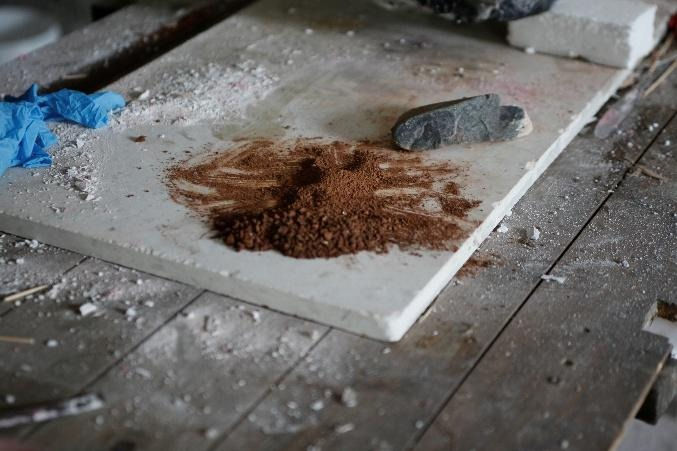
Figure 1: Preparing dry red soil for work experimentation

Figure 2: Examples of resin mixture: mixed media
Throughout all this process, I could understand that the Jungian tension and the artist’s tension operate through the same underlying dynamic. The psyche develops when conflicting forces are not prematurely resolved but allowed to interact. In artistic practice, this tension often emerges between form and chaos, intention and accident, tradition and innovation. So does the art practice develops when all components taking part in the creative process are allowed to interact as well. Nonetheless, the artist must sustain this interaction until an image, gesture, or work emerges through a new synthesis. In this way the creative process establishes a connection between inner and outer worlds, linking mental transformation within material experimentation. Therefore, I can speculate that the artwork can also be understood as a resolving progress.

Figure 1: Kristian Zara, material mixture, sculptural work in progress, 2026
Persona and Curatorial Staging
Within the project Self in Flux, I approached the concept of Persona as a carrier of psychic complexity. I assigned to this figure an individual and collective weight related to memory, emotion, perception, and mental organisation. Steiner’s work, Art as Spiritual Activity, was influential in establishing the persona concept as the main idea through which I could conduct my investigation and experimentation. This framework allowed for a parallel between alchemical processes and material processes – both intellectual and physical. Gaston Bachelard’s The Poetics of Space further informed my understanding of the artistic outcomes as expression of the lived environment and of the society in which I partake.
Steiner’s perspective on art as a bridge between the sensory and the spiritual supports my methodology: the artist must penetrate the material to reveal the spirit. Similarly, Bachelard’s concept of the house as a shelter for the “dispersed being” informed my approach to curatorial presentation. As Bachelard writes, “Without the shelter of the house, the human being would be a dispersed being.” In Self in Flux, the exhibition space functioned as such a shelter – a vessel that contained the dispersed fragments of the Persona, allowing them to interact and integrate.
The artworks produced within this project function simultaneously as unified and distinct personas. Although materially static, they remain psychologically and conceptually dynamic. Each work operates as a presence – an actor that does not move physically, yet affects the viewer through its very existence. The exhibition space itself, marked by traces of the past and activated in the present, became a container – another alchemical vessel. By curating them all together in the space, Mercurius emerged unconsciously, and a theatrical echoing sense took hold of the exhibition I was preparing to realize.

Figure 2: Kristian Zara; Mercurius, Exhibition Space View, 2026
Each Work on Its Own, Creating the Whole
Material Experimentation – The Chaotic Persona

Figure 3:Kristian Zara; Material experimentation outcome, 2026
The idea begun from an invisible field, while the form begun from the material experimentation (K. Zara, Mercurius, 2026).
If the exhibition space functions as an alchemical vessel, then the individual artworks are the elements undergoing transmutation. In the initial phase of Self in Flux, I focused on material experimentation to embody what I term the Chaotic Persona. This state represents the unrefined, unassimilated aspects of the self – the raw psychic material that precedes integration. In alchemical terms, this correlates with nigredo, the stage of blackening, decomposition, and chaos, where the prima materia must be broken down before it can be reconstituted.
I began the practical process by experimenting with various materials, with limestone serving as the primary element in most mixtures. I chose limestone for its profound symbolic nature: it embodies the cycle of loss and renewal. The material possesses a unique ability to dissolve, dry into a pure white powder, and then reform into a solid physical structure. This mutability mirrors the psychic processes I wished to explore.
In this phase of my practice, a need arose to transcend the forms and techniques I had previously used. This necessity was driven by three factors. Firstly, I needed to find a visual language capable of conveying the project's fragments and concepts in a way that could be fully absorbed by the mind and senses of the audience. Secondly, I desired to acquire new knowledge and techniques, specifically to bring opposing elements together into a single form. Thirdly, the entire experimental process was conceived as an alchemical operation designed to reorganize the chaotic persona.
Each material carries a specific meaning that transforms into language once placed within the context of an artistic framework. These materials activate unconscious content deposited in the human psyche. Limestone, for instance, symbolizes the changeable nature of memories and imagination, paralleling the concepts of loss and renewal. Soil serves as the foundation of human civilization and fertility – the ground in which humanity cultivates its existence and culture. While straw and coffee bags strongly affirm our cultural roots, resin and marble dust act as added elements, representing modernity within cultural development. These contemporary materials can be seen as recent ways of living integrated into the present organization of our societies.
Mercurius – The Messenger

If the axis is the field of tension and the materials are the raw elements of transformation, then Mercurius is the operative agent – the ladder, the messenger who navigates between them. In the alchemical tradition, Mercurius is the spiritus mercurius, the fluid, volatile spirit that dissolves the old (the nigredo of the Chaotic Persona) and unites opposites. He is neither the starting point nor the final product, but the movement itself.
As you can see in the artwork, Mercurius attempts to push the individual – already fragmented and unsettled by the "unknown known" – toward a union with the self, situated amidst a fragmented environment. This work serves not merely as a depiction of humanity's fragmented present state, but as an enactment of the mercurial process driving reformation. It also marked the first tangible output of the project – a moment of uncertainty where I experienced the initial surge of the tension previously described.
The necessity of externalizing that inner state caused the Mercurial archetype to surface within my practice. Here, the concept of "holding the tension" reappears: by reflecting on alchemical and psychological texts and experimenting with materials – through spontaneous writing and drawing – I was able to sustain the urge to create a definitive work, at that first initiation. This process spanned three weeks of reflection and spatial creation, engaging both rational and irrational mechanisms within a single creative field before I could finalize the artwork.
At that time, however, the clarity of this process remained obscure; I did not fully grasp what was unfolding. Understanding emerged later, following a period of internal reflection. Now, in the act of writing about this moment, the process has clarified further: I recognize that the archetype of the mediator awakened, which drove my artistic practice into the axis field of "is" and "becoming."
Matter In Paradox and The Suitcase On A Building

Figure 5: Kristian Zara; Matter in Paradox and the Suitcase on a Building, 480x330 cm, 2026
The work embodies the maternal principle – a ground that shelters while it weighs down. The layered, earthen mass evokes the Great Mother as womb, soil, and vessel, within which the figure is both held and constrained, nurtured and threatened. This ambivalence reflects the archetypal Mother’s dual nature, where protection and engulfment coexist. The question "Why man…", inscribed on the coffee bags, resonates with habitual behaviors in Albanian society – a culture grappling with political corruption and the abuse of power since 1991. This interpretation is deeply influenced by Jungian archetypes and the Collective Unconscious.
Narcisius (Narcissus) In Retort – Semi-False Persona

Figure 6: Kristian Zara; Nacisius in retort, oil on canvas, 150x130 cm, 2025
The retort is not a pristine vessel, but a raw, lived environment where rigid personifications form an edgy room – first of a psychic nature, and later appearing through physical manifestation. Here, Narcissus is not about vanishing into the dark room; he is about being contained, pressured, and transmuted in shadow. He faces a choice: to undergo a unified transformation or to continue a fragmented existence. This work also builds upon the concept of acknowledging and accepting your own shadow, and meeting the false self in the realm of transforming possibilities.
Refuge From Oneself – The Shadow

Figure 7: Kristian Zara; Refuge From Oneself, mixed media, 2025
Deeply resonating with Albanian history, the bunker can be seen as the hidden characteristic of man – isolated and half-lit. Pushed by fear to build physical security from the aggressor, he turned into an observer of the observed (himself). This has been shown during the Albanian dictatorship regime, where the leader turned against his own people, projecting the internal fear outside to the society. As a matter of fact, from my own experience, this projection continuous even nowadays. The number nine signifies the experience that must be completed, revealing the importance of accepting who you really are. Otherwise, denying the internal fear sourced by the shadow will make you imprison the true nature of the Self – as it happened, and happens, in Albania in several aspects of the society. Furthermore, this psychic state reflects to individuals with authoritarian characteristics who, driven by similar fears, transform into dictators.
Refuge from oneself is no sanctuary of walls, but a trembling threshold. It is the vessel where shadow and light converge, where the double waits in silence. To flee the self is to enter its deepest chamber, to discover that refuge is not escape but transformation: completed experience. To understand who you are is to abandon the mission of securing the fear-driven mind.
Coniunctio Oppositorum – The Philosopher

Figure 8: Kristian Zara; Coniunctio Oppositorum, oil on canvas, 300x200cm, 2025
The philosopher’s stone, placed between the moon and the sun, becomes the bearer of philosophy. Within the alchemical vessel, the persona moves in the flux of these opposites. Verticality is the axis mundi (axis field), the unifier of layers, while horizontality is the plane where opposites meet to interact between them. The coniunctio is the trembling embrace of opposites, where light meets shadow, where energy becomes body. It is the crucible in which the self discovers that transformation lies not in shifting positions, but in the union of what was once divided. In practice, what was divided before I could the complete the artwork, was my thinking of the composition that should assembled all components I describe above. The old way of doing with new ways of experimenting to do something outside classical composition.
Symptomatic Recurrence

Figure 9: Kristian Zara; Symptomatic recurrence, mixed media, 480x280cm, 2026
This cycle of dissolution and recombination represents a state where unfinished practice results in inner stagnation. Each return of the symptom serves as a reminder of the work left undone, mirroring a circular movement and underscoring the need for collective integration. This recurrence parallels the alchemical solutio, where the structure must dissolve repeatedly to release its essence. As Jung posits, the symptom persists until the fragmented parts of the Self are no longer suppressed but consciously integrated into the axis field (praxis) of growth.
Incomplete Shift

Figure 10: Kristian Zara; Incomplete Shift, mixed media, 430x310cm, 2026
This work serves as a warning: when rulers exploit laws for personal power, they corrupt the polis. Consequently, the polis becomes a vessel harboring corruption, its structure rooted in trauma. This nature of trauma acts as an emotional and neurotic block, disrupting the axis field where the movement between the "is" and the "becoming" pauses.
Fragmented Conception

Figure 11: Kristian Zara; Fragmented Conception, oil on canvas, 2025
Fragmented conception is the seed scattered across the thresholds of the unconscious, the thought that arrives in shards rather than sentences. It is the unfinished birth of the prima materia – the raw, chaotic base that demands expression before it can take form. It is the splintered mirror reflecting the multiplicity of the Persona, a promise of a whole that has not yet gathered itself within the axis field. Yet, this fracture is not a defect; it is the necessary condition for the artwork to become. In its very breakage lies the possibility of flux, for it is only when the form is cracked that the Mercurial spirit can enter, dissolving the rigid edges of the “is” to initiate the “becoming.”
Toward Fusion

Figure 12: Kristian Zara; Toward Fusion, resin and wax, 2026
This work marks the pivotal transition from dissolution to synthesis. If Fragmented Conception was the scattering of seeds, Toward Fusion is the moment the roots begin to intertwine. Here, the shards of the Chaotic Persona are no longer disparate; they are drawn together by the gravitational pull of the Self.
It embodies the alchemical Coniunctio Oppositorum – the sacred marriage where opposing forces cease their struggle and begin to embrace. The tension, held throughout the project, now generates heat, fusing the lead of trauma with the gold of awareness. In this work, the axis field tightens: the vertical urge for spiritual growth converges with the horizontal weight of material existence. It is the trembling threshold where the "is" and the "becoming" finally touch, no longer as enemies, but as partners in the creation of a unified whole.
Persona, The Veiled Self, And The Space Beyond

Figure 13: Kristian Zara; Persona, The Veiled Self, And The Space Beyond, mixed media, sculptural installation, 2025
The Self is a complex dimension where history, memory, genetics, and experience intertwine. Yet, contrary to post-structuralist views – such as Judith Butler’s theory that identity is purely performative – authenticity remains the distinctive core of the individual. As explored earlier, it is precisely this quality that renders us distinguishable from one another, revealing the unique imprint each person carries – a special ingredient that cannot be replicated. This originality is often obscured by the culture of appearances and by the dominance of the archetype persona, which pushes the human being toward a false self adapted to socio-political demands. When Persona gains excessive power, the authentic self loses its space, bringing spiritual turmoil and psychic turbulences.
The Semidark Vessel

Figure 14: Kristian Zara; The Semidark Vessel, video art installation, 2026
This installation comprises two video works and a structural element, forming a unified narrative of transformation: embedding old knowledge to new discoveries.
The first work, projected onto the wall, is titled In Search of the Unknown Known. It visualizes the knowledge inherited within the human psyche – latent truths we possess but are not initially aware of. The video work suggests that this inherited knowledge is not static; it is a dynamic presence we discover and unpack throughout the trajectory of our lives.
The second work, titled Rubedo, is projected onto an installation of carbon papers inscribed with alchemical symbols. This surface acts as a permeable membrane, absorbing the projection to bridge the gap between the material and the ephemeral.
Beneath this projection stands a metallic structure symbolizing the ladder, flanked by two columns at the top marking the entrace. This construction serves as a physical anchor for the four stages of alchemical transformation: nigredo (blackening), albedo (whitening), citrinitas (yellowing), and rubedo (reddening). Together, the works create a synthesis in the "semidark vessel” – a space where the seeker moves within the unconscious inheritance of the "unknown known" to explore how the final integration of the self can be made possible.
Conclusion
Self in Flux treats Mercurius as an operative principle rather than a mere metaphor: the mercurial figure becomes a procedural model that shapes material choices, studio operations, and reflective practices, so the art project functions as a disciplined activity for exploration and material or medium unification. In Jungian terms, Mercurius is both the material agent of change and the image of the unconscious; this doubleness authorizes a practice that moves between inner dynamics and outer form.
Practically, the mercurial principle is translated into three studio rules: enact mental fluidity through diverse media and reflective surfaces that register instability and permeability; enact mediation by making objects that invite interaction and dialogue, interfaces that agent exchange between viewer and maker; and enact ambiguity by deliberately combining oppositional strategies – control with chance, figuration with abstraction – so the artwork itself embodies the tension it seeks to hold. These procedural choices are not decorative analogies but operational constraints that determine sequencing, material experiments, ways of creating and modes of documentation.
To make transformation traceable, the practice defines observable indicators: recurring motifs that resolve or recombine, shifts in diary language from fragmentation to integrative narrative, altered decision patterns in material selection, and audience responses that reflect new relational stances. Exhibiting therefore visual artworks with short reflective texts and welcoming audience to become psychically active, producing a triangulated record that links neurotic movement to material outcomes.
Ethically and methodologically, the Mercurius model is framed as a transformative practice rather than clinical therapy: it supports integration and self-knowledge while acknowledging limits and the need for consent when others’ wounds are implicated. By naming which facets of Mercurius are privileged at each stage – fluidity, mediation, ambiguity – the theory offers a transparent map for readers to follow: a symbolic image made rigorous enough to guide studio procedure and precise enough to yield measurable traces of inner change.
Bibliography
Bachelard, Gaston. The Poetics of Space. Translated by Maria Jolas. Boston: Beacon Press, 1994.
Butler, Judith. Gender Trouble: Feminism and the Subversion of Identity. New York: Routledge, 1990.
Jung, C. G. The Archetypes and the Collective Unconscious. 2nd ed. Translated by R. F. C. Hull. Princeton, NJ: Princeton University Press, 1981.
------------. Mysterium Coniunctionis: An Inquiry into the Separation and Synthesis of Psychic Opposites in Alchemy. Translated by R. F. C. Hull. Princeton, NJ: Princeton University Press, 1970.
------------. Two Essays on Analytical Psychology. 2nd ed. Translated by R. F. C. Hull. Princeton, NJ: Princeton University Press, 1972.
Steiner, Rudolf. Art as Spiritual Activity: Rudolf Steiner's Contribution to the Visual Arts. Edited by Michael Howard. Hudson, NY: Anthroposophic Press, 1998.
Author
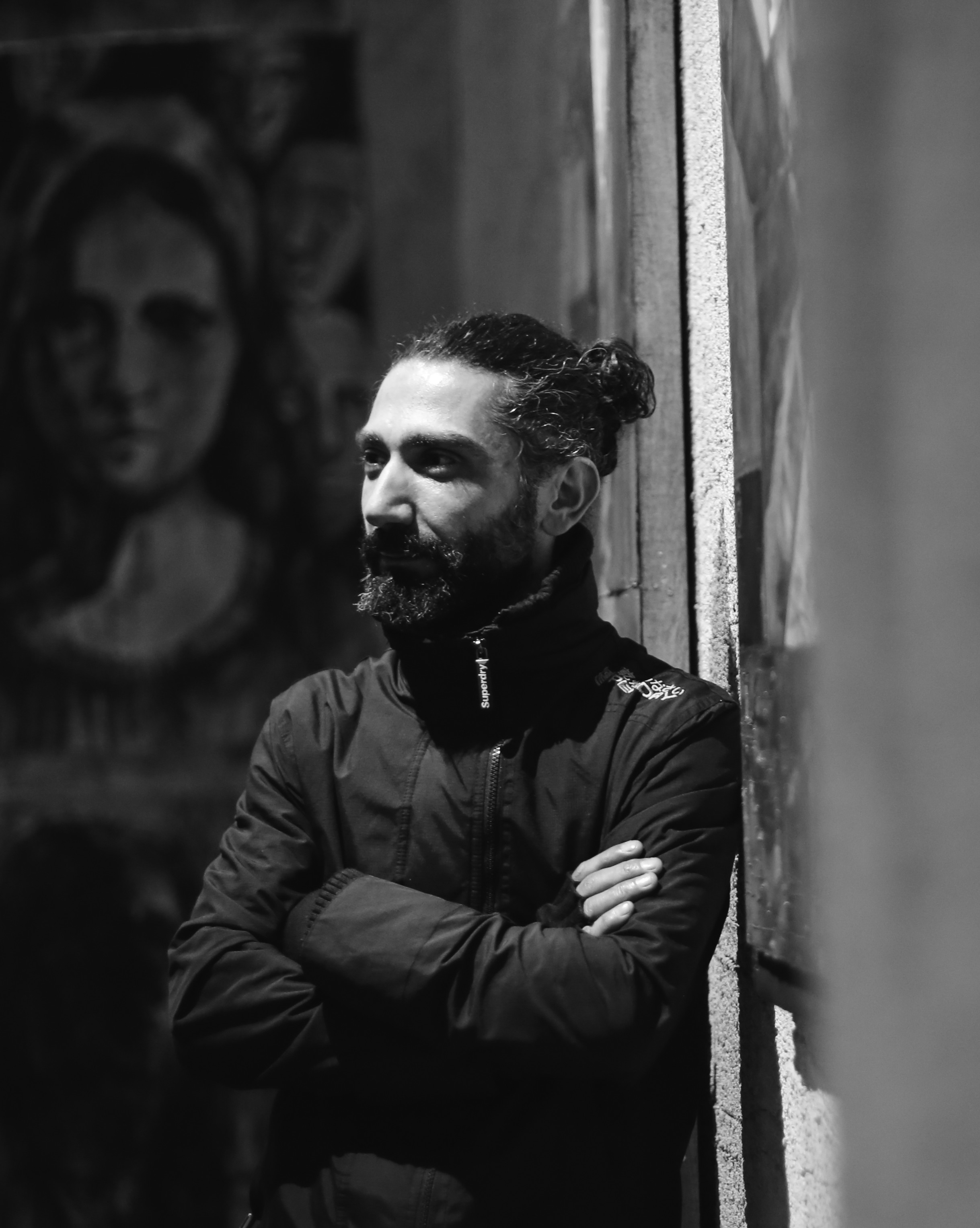
Kristian Zara

Born in 1986 in Elbasan, Albania, Kristian Zara is a multidisciplinary visual artist whose practice engages with memory, materiality, and philosophical inquiry. Raised in the aftermath of a collapsing dictatorship, and within a politically persecuted family, his early experiences informed a lasting sensitivity to inherited trauma and the complexities of collective memory. His ancestral background traces to communities of shepherds and wool workers in southern Albania and northern Greece, where textile traditions such as qilim functioned as both utilitarian objects and carriers of symbolic meaning. This lineage, combined with a bilingual upbringing in Albanian and Aromanian (Vlach), shaped his early understanding of identity as layered, fragile, and culturally embedded. Zara began his formal artistic education in Elbasan before continuing his studies at the Athens School of Fine Arts, where he completed an Integrated Master’s degree across multiple disciplines. His years in Athens were marked by active engagement in exhibitions, stage design, and collaborative artistic environments, contributing to the formation of a multidisciplinary approach. In 2016, he completed a second Master’s degree in Art, Society, and Publics at the University of Dundee, further developing a research-oriented practice that integrates writing, theory, and artistic production. His recent work focuses on the intersection of personal history and collective memory, exemplified by the installation The Present Past (2024), realized at the former Spaç prison. Through a practice informed by Jungian thought, psychoanalysis, and alchemical symbolism, Zara approaches art as a transformative process, where material and meaning converge.
Credits
Artworks and text created by Kristian Zara, with partial support from Swiss Cultural Fund in Albania.


Comments