


The Ambiguous Object

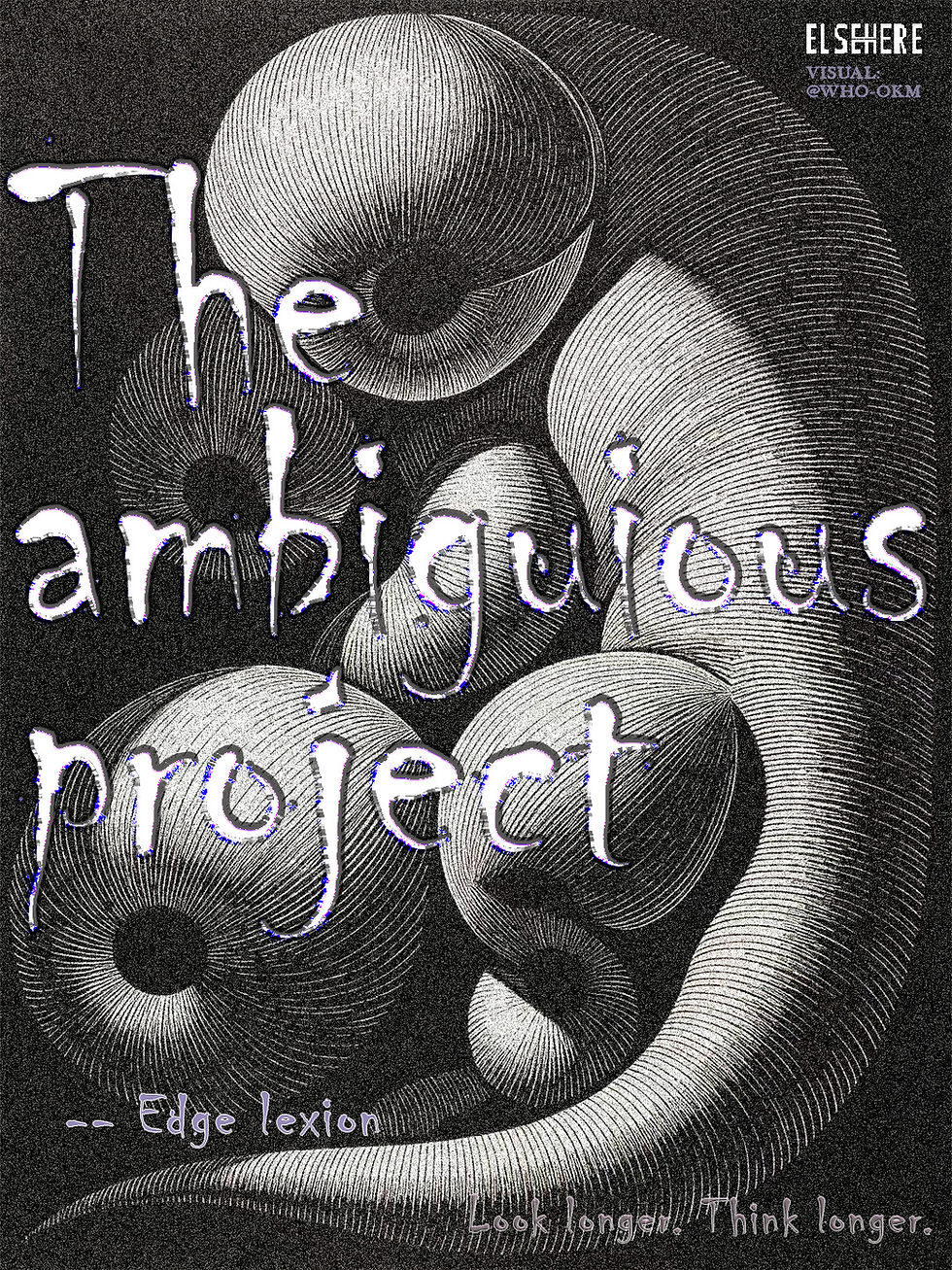
Incomplete Form, Participatory Seeing, and the Moment Imagination Begins
Some objects do not settle.
You see them, and yet cannot immediately say what they are. They resemble one thing, then another. They resist being fixed by a single name. You might call this uncertainty, or openness, or indeterminacy. Whatever term one chooses, the structure is the same: the object refuses to arrive as a completed fact. It does not hand over its meaning all at once. It offers clues, partial outlines, suggestive forms. It asks the viewer to participate in finishing what has not yet been decided.
This is what may be called the ambiguous object.
The phrase is not a strict academic term. It is a working concept, but a useful one, because it points to something larger than mere visual vagueness. It describes a condition in which meaning is not fully contained within the object itself, but emerges in the unstable zone between object and viewer. To encounter such an object is not simply to receive information. It is to begin projecting, guessing, supplementing, misrecognizing, and associating. One does not merely see. One completes.
And for that reason, ambiguity is not simply a flaw.Often, it is the condition under which imagination begins.
I. Why Ambiguity Activates Perception
Seeing is never passive.
What appears to be immediate recognition is already a complex process of comparison, projection, and categorization. We take visual information, however partial, and connect it to memory, habit, prior knowledge, fear, and desire. Perception is always being shaped by what the viewer brings to it.
This is why an object with softened boundaries or incomplete definition so quickly activates the mind. The brain begins to close the gap. It searches for likeness, for pattern, for the nearest familiar form. Cloud-gazing offers the most ordinary example. The cloud itself has no fixed identity, yet one person sees a dog, another a ship, another a hand. The image is not contained in the cloud in any stable sense. It is produced in the meeting between indeterminate form and interpretive desire.
Psychology has long identified this mechanism. Gestalt theory, especially in its account of closure, shows how the mind tends to complete incomplete figures. The viewer does not remain calmly with the fragment. The fragment solicits completion. But what psychology explains as a perceptual habit, aesthetics can recognize as a formal strategy. Some works deliberately place the viewer in that moment before completion is secured. They do not present a fully sealed object. They hold the form in suspension just long enough for the viewer’s imagination to become visible.
At that point, the ambiguous object is no longer merely seen.It begins to organize the act of seeing itself.
II. Not Emptiness, but Invitation
A powerful ambiguous object is not simply blank.
It is not an empty surface onto which anything whatsoever may be projected. It is something more precise than that. It is closer to a half-open door. The door is not closed, so one knows there is something beyond it. But it is not fully open either, so the interior cannot yet be grasped. It is precisely this narrow interval, neither concealment nor disclosure, that captures attention and draws thought inward.
The ambiguous object works in the same way. It does not reject meaning. It delays it. It does not refuse interpretation. It redistributes interpretation, making the viewer responsible for part of the work. The object asks for memory, for fear, for previous experience. It does not change in front of you. Rather, it makes visible how quickly your own mind begins to move.
A coat rack in a dark room is a simple example. Before the light is turned on, it may become a person, a creature, a lurking presence, or some undefined threat. The coat rack itself has not transformed. What changes is the viewer’s relation to it. Ambiguity gives imagination its fuel. When the light comes on, the object resolves and the imagined figure vanishes. Yet those few seconds before recognition was stabilized were precisely the moment in which the mind was most active.
This is the power of the ambiguous object.It does not speak, yet it makes the viewer begin speaking.It does not deform itself, yet it produces the experience of transformation.It does not offer a conclusion, yet it provokes one.
Ambiguity, in this sense, is not the absence of meaning but its postponement. It delays judgment, delays naming, delays closure. And in that delay, perception becomes more complex than simple recognition.
III. Open Work and the Incomplete Form
Twentieth-century aesthetics returned repeatedly to this question of incompletion. Not because incompletion was understood as weakness, but because it suggested a different model of the artwork. A work need not be a sealed and self-explanatory totality. It can be an open structure, one that continues to generate meaning through the activity of its viewers.
This is one of the major insights of Umberto Eco’s The Open Work. Certain works are not “unfinished” in the sense of being deficient. They are constructed in such a way that indeterminacy is part of their form. They leave spaces, intervals, suspensions. The viewer or reader is not standing outside the work as a neutral observer, but entering a field of participation. Meaning is neither arbitrary nor fully predetermined. It is produced in the encounter.
The ambiguous object is one of the clearest expressions of this condition. It is neither a fully defined entity nor a pure void. It exists between “is” and “is not.” One cannot entirely say what it is, and yet one cannot say that it is nothing. It hovers in a threshold state, and this threshold is precisely where imagination is set to work.
Art has always depended on such thresholds. Some experiences lose their force the moment they are over-explained. Some forms become inert the moment they are overdefined. Ambiguity protects a fragile but vital phase of meaning, the phase in which form has appeared, but not yet closed; the phase in which the object remains active because it has not surrendered all of itself at once.
IV. Borowczyk and the Aesthetics of Indeterminacy
The films of Polish animator Walerian Borowczyk offer a particularly strong intuition for this structure.
In his work, objects do not remain fixed within stable identities. A drifting curtain may resemble an angel or a ghost. A shadow may appear as a face or remain only a shadow. A sound may seem to belong to the diegetic frame, or to the viewer’s own mental completion of that frame. The object does not settle into one category. It continues moving between possibilities.
What matters here is not which interpretation is “correct.” What matters is that the work keeps certainty open. The image is not presented as finished information. It is experienced as a process of unstable recognition. The viewer thinks the object has been identified, only to find it slipping elsewhere. Meaning does not arrive as a clear statement. It unfolds as hesitation, revision, and renewed attention.
This is why ambiguity in Borowczyk is not softness or indecision. It is a formal intensity. It compels the viewer to pause. It refuses the speed of immediate recognition. It asks the viewer to admit that perception is never as secure as it first appears. In doing so, it restores an object to the condition of event. One is no longer presented with a thing fully known. One is drawn into the labor of coming to know, and of discovering how much of that labor comes from oneself.
V. Yūgen and the Beauty of What Is Not Fully Revealed
East Asian aesthetics offers another language for this structure.
The traditional Japanese concept of yūgen comes very close to the ambiguous object in this sense. Yūgen is not mere vagueness, nor ornamental obscurity. It refers to a beauty that is only partially visible, only partially sayable. A mountain range faintly suggested through mist. Moonlight filtering through branches. A form glimpsed, but not given in full. It belongs neither to absolute clarity nor to complete darkness. It lives in between.
This is why yūgen is often more moving than explicit revelation. Once everything has been fully shown, fully explained, fully illuminated, the viewer is left with little room to continue entering the work. What remains enduringly compelling often retains something withheld. It does not exhaust itself in a single act of disclosure.
Zeami’s phrase “concealment is the flower” names this logic beautifully. Not everything must be revealed at once. Reserve is not deficiency. It is a way of preserving life within form. The ambiguous object follows the same principle. It neither entirely closes nor fully exposes itself. It knows that if meaning is delivered all at once, imagination is no longer required.
VI. Why Ambiguity Matters in a High-Definition World
Contemporary visual culture prizes clarity.
Everything is expected to be sharp, legible, high-definition, instantly classifiable. Objects should identify themselves at once. Images should explain themselves quickly. Language should deliver meaning with maximum efficiency. In such a culture, ambiguity is easily treated as failure, as if uncertainty were merely a problem to be corrected.
Yet this is precisely why the ambiguous object matters now.
It reintroduces duration.It asks for pause.It asks the viewer not to conclude too quickly.It allows the object to remain, for a moment, as a problem rather than an answer.
This is not an argument against clarity in every context. It is an argument for recognizing that not all forms of meaning should be optimized for speed. Some experiences cannot be properly inhabited if they are immediately categorized. Some objects matter precisely because they resist instant resolution. Art, at its best, does not always make the world more database-ready. Sometimes it returns us to those regions of perception that have not yet been closed.
The ambiguous object is not a visual failure.It is a threshold state in which meaning is still forming.It does not make the world simpler. It restores complexity to the act of seeing.
And perhaps that is its deepest invitation. It asks us to suspend the impulse to name too quickly, to classify too early, to close interpretation before it has had time to breathe. It asks us to allow an object to remain partially undecided, and to acknowledge that some of the most powerful experiences in art arise precisely in that condition of unfinished recognition.
The ambiguous object does not finally tell you what it is.It reveals how urgently you want it to become something definite.
Art, in its strongest form, interrupts that urgency.It makes you stop.Look longer.Think longer.And finish the story yourself.


Comments