


Fraught | Inside-Out: A Conversation with Pam Patterson
- ELSEHERE
- 1 day ago
- 19 min read

Pam Patterson’s responses resist neat framing. She moves through legacy, embodiment, humor, pain, pedagogy, contradiction, performance, and what remains when the body can no longer be taken for granted. What follows is an edited text-based conversation drawn from her written responses. We have preserved the shape, vulnerability, wit, and force of her voice, while lightly revising for clarity and publication.
ELSEHERE: If this is not simply an interview, but a record that may remain, what do you hope people carry with them after hearing or reading you now, at this stage of your life and work?
Pam Patterson: I think what captures me is this idea of legacy, of how our elders and ancestors rest and live in our memory and serve us in unpredictable ways.
ELSEHERE: Your essay moves between theory, performance, pain, memory, and irony without fully separating them. What kind of space would you like this exchange to make possible that standard interviews usually do not?
Pam Patterson: I was talking recently to much-loved colleagues of mine, Michael Lee Poy and Lillian Allen. We were speaking about what is unique and valued in the work that we do as cultural producers and animators. Michael designs and builds Caribana-like parades here in Toronto and in Trinidad. He spoke about the fact that architecture, as he teaches structural and industrial design, is so theoretically and design-driven and, while people may be consulted during the process, architects are by and large creating structures. Lillian speaks similarly about her work as a Dub poet. Theory will get you only so far, and then there is passion. It is the messiness of what we do that disturbs the theoretical, the predictable, the fixed, that gives and acknowledges life.
ELSEHERE: Before “feminist academic” and “disability performance artist” became names you could use, was there an earlier way you understood yourself in relation to the world, or in relation to your body?
Pam Patterson: It’s funny that you ask this because when I made the decision to begin a master’s and PhD, it proved to be extremely challenging. I had been a performance artist and worked in theatre, movement, and dance for a number of years, and the academic work seemed so restrictive. I was fortunate, though, to do both of these graduate degrees at the Ontario Institute for Studies in Education here at the University of Toronto. The Institute proved to be much more innovative than what I had been previously used to in academe. I was able to complete one of the first of the Institute’s two arts-informed dissertations.
Nevertheless, I performed my master’s research in rebellion, naked on the Institute’s board table with a computer disc in my mouth. The work was entitled This is my body given for you academe…
As a dancer, mime, actor, and movement coach and teacher in my early years, my body was all I had. I didn’t own a car, had few clothes, a house, or even a steady job. It was my only asset.
ELSEHERE: Looking back, was there an early moment when you became aware that how you appeared in the world and how you felt within yourself were not the same thing?
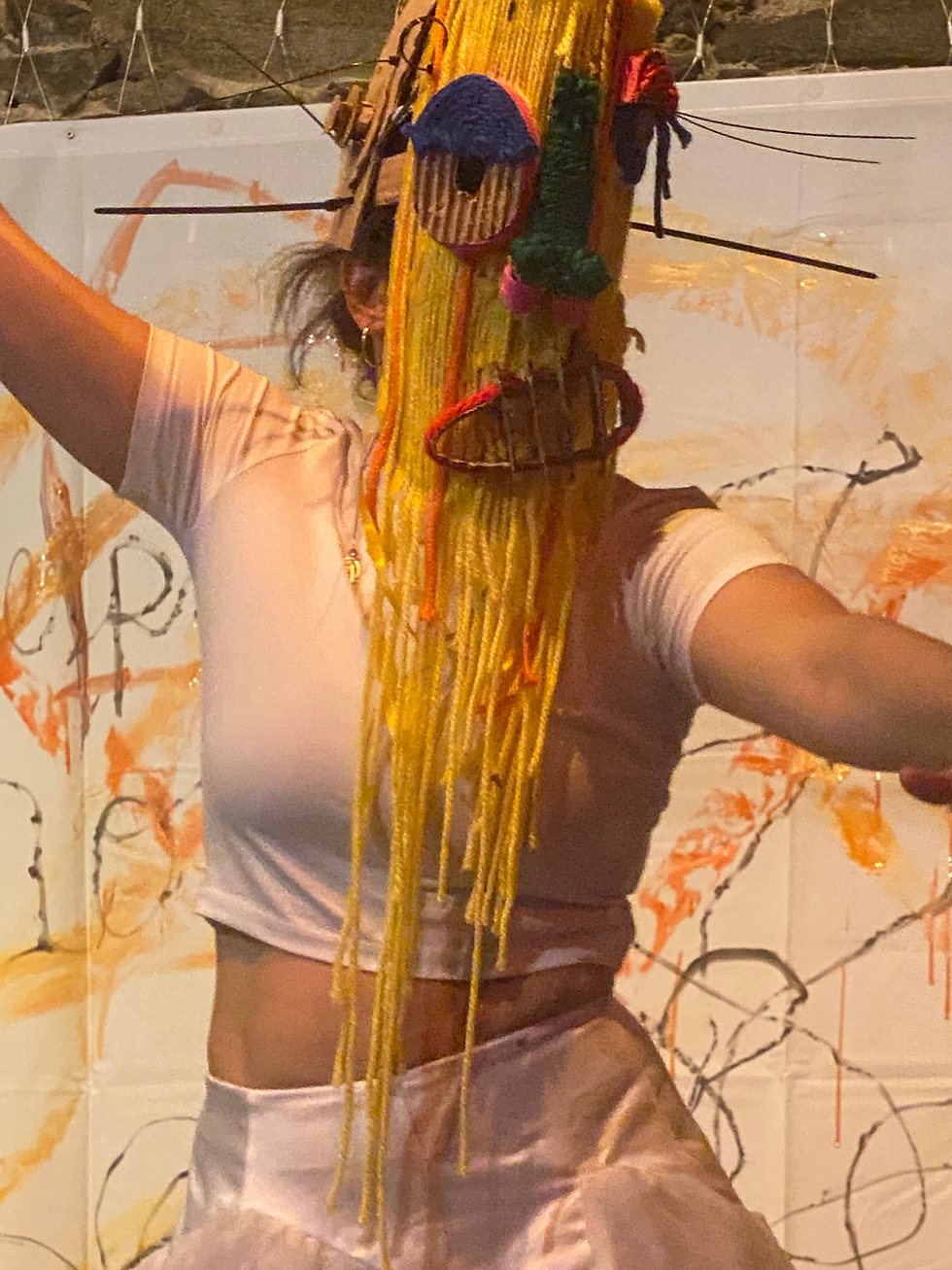
Pam Patterson: Always. But it began to appear more fully in performances in the early 2000s. Here is a text excerpt from my performance Body as Site/Sight, which opened the 7A*11D Performance Festival at A Space Gallery, Toronto, in 2004. I was working at the time as a museum educator at the Art Gallery of Ontario:
Welcome to the gallery
It is here that we look, are taught how to see, to interpret what we see in a very specific way.
And then to teach it, to reinstitute it.
It is seeing which fixes our place in the surrounding world.
And the relation between what we see and what we know is never settled.
Our vision is continually active, continually moving, continually holding things in a circle around itself, constituting what is present to us as we are.
My body confronts not just as an immediate sight, but as experience, my experience.
In the looking we/you see woman-in-wheelchair-with-cane interpreting woman-as-painted.
Where is the language for this? How is this “settled”?
When I feel myself being observed, everything changes. I constitute myself in the process of “posing,” I instantaneously make another body for myself, I transform myself in advance into an image.
I pose, I know I am posing, I want you to know that I am posing, but this in no way alters what I am.
If only I could be given a neutral, anatomic body, a body which signified nothing.
I am supported and maintained in my passage to immobility: to become an object made I am at the same time the one I think I am, the one I want others to think I am, and the one others think I am.
But I, already an object, do not struggle. I foresee that I shall have to wake from this bad dream even more uncomfortably. I am turned, ferociously, into an object, put at their mercy, at their disposal, classified in a file, ready for the subtlest deceptions.
But I refuse to inherit anything from another eye than my own.
Absolute subjectivity is achieved only in a state, an effort, of silence, sitting in silence.
ELSEHERE: Was there an early encounter, with art, illness, gender, authority, or education, that quietly taught you what you were not supposed to show?
Pam Patterson: Oh, of course. There has always been the fear of exposure, of ridicule, that I might lose my job or be seen as less than. For many, many years, I was able to compensate to a certain extent and hide the reality of what I was dealing with physically. Disability was not a cool thing as it seems to be now. I was writing and performing about this twenty years ago when it was impossible to find an accessible venue.
I was hired to direct the movement program at the University of Toronto, and at the time I was wheelchair-bound and simply could not get to the studios that I was supervising. I asked for accommodation, but of course the elevator only went to the second floor, not to the basement, not to the third floor, and all they offered me as accommodation was a computer. I eventually had to quit the job.
ELSEHERE: In “Fish-Slapping,” absurdity does serious conceptual work. What does absurdity allow you to say about feminist disability that a more stable or respectable language would fail to hold?
Pam Patterson: It seems that some feminist academics may be suspicious of humor. I had originally submitted this to a feminist journal, and the one thing they hated was the Monty Python reference, as they simply did not get it. They wanted me to explain it in detail, and I had to tell them that the whole point of this writing was to articulate that often you can’t explain why humor works the way it does. That is the beauty of it. It uncovers the deeper, often unnameable, as Roland Barthes, in Camera Lucida, might say, and in doing so it exposes the banality of the studium, or the social. That which is unnameable pierces this with what he refers to as the punctum, an emotional and unexplainable phenomenon that arrests us at our very core.
Humor can expose everything from the leaking obscene body to feelings of inadequacy and shame. But it does so in a way that we can bear.
ELSEHERE: When did you begin to understand that feminism and disability were not simply parallel commitments, but forces that could unsettle each other?
Pam Patterson: This intent to work on the feminism and disability relationship was fairly recent, though I had certainly been exposed to this potential irreconcilability in cultural work. I really wasn’t sure if I could establish a reasonable way of framing a relationship between them, and then I began to reflect on my own work. One thing that is useful, when you have been making work for decades, is that you have distance from which to reflect back on whence you came. Core thematics often reappear in different forms and serve then to enlighten and deepen understanding. It is a visceral and moving experience.
In cultural contexts, curators are often unable to reconcile the two. I was curating a project years ago called genderTroubling, an exhibition and series of events at XPACE Gallery in Toronto. This must have been at least ten years ago. One of the artists, Loree Erickson, who named herself as a femme gimp porn star, had been applying at the time to festivals where she could potentially screen her films. The feminist film festivals found the disability content too unsettling, and the disability-identified spaces had difficulty with the explicit sexual content around the female body. Interesting, eh? Of course, I screened her work. SEXXY and WANT were the two titles. I also wrote about this project for the online journal Learning Landscapes.
ELSEHERE: You write that articulating a productive relation, or lack thereof, between feminism and disability is “not an easy sell.” What has made that relation so difficult to sustain, intellectually, institutionally, or personally?
Pam Patterson: There has always been a mainstream resistance, that I’ve experienced as a cultural worker and as an academic, toward feminism in particular and women in general. My doctoral work looked at how women self-educate through artist collectives and why this is necessary. The perception of the female artist, while it has improved, is still skewed. I can remember as early as the 1980s when someone adamantly argued with me: why would I do political work using a feminist positioning when I really should be involved in a larger, more inclusive, usually male-run, socialist Marxist forum?
You also rarely hear the word feminist in the academy anymore. There is still that naïve and uninformed perception from some graduate students that a feminist is simply someone who hates men. And no one corrects them. Of course, I occasionally prance out ineffectually and attempt to say something, anything, but it is often rebuffed by facilitators who think I’m just some old fart stuck in a second-wave feminist consciousness-raising time warp. Sigh.
I realize I haven’t addressed disability here. It wasn’t until I saw the book by Hall, Feminist Disability Studies, that I began to explore linkages. There has also been a lot of attention paid to disability and disability studies within the last few years, though I hesitate to say that things have improved much around financial support and inclusive practices for those of us with disabilities.
ELSEHERE: Has there been a moment when feminism gave you language but not room, or when disability gave you reality but not recognition?
Pam Patterson: Oh God(dess), yes. I remember being invited to a forum in Kingston to discuss whether a women’s centre at Queen’s University should rename itself as the Centre for Feminist and Gender Studies, or the Centre for Gender Studies, or the Centre for Gender and Cultural Studies, and so on. The keynote speaker for this forum was a feminist theorist who, frankly, was quite brilliant in her theoretical reasoning, but she had no idea how this work might relate to the experiences of real women. Praxis was not her forte. One of the other attendees, a professor from Queen’s, a Canadian Pakistani scholar and artist, challenged her, saying that most of what she spoke about would not mean anything to, or improve the lives of, most women in her country.
And certainly, when I first started publicly performing around disability in international festivals, which was around 2004, disability was a dirty or silly word, or was simply not recognized as a reality or strategy.
ELSEHERE: Over decades, as pain, fatigue, and bodily limitation intensified, how did your body stop being merely the subject of thought and become a method of thought?
Pam Patterson: I love this question, but I’m really not sure how to answer it. I think more than anything it speaks to a deeper sense of how I experience embodiment. Everything that I am or have felt or have thought is deeply embedded in my very bone marrow. I’ve always been someone who births a group, generates an energy, or creates a phenomenon. I am therefore embedded in my study rather than acting as a researcher who studies a phenomenon outside of myself.
It’s important for me that my methodology, whatever that may be, reflects the activity of those with whom I work, the way people think, the way people connect, the way we experience ourselves with and for each other. Therefore, the form that the research takes, in writing or in performance or in visual work, needs to express and honor that process and relationship. It should not be pressed to serve a fixed academic mandate or structure.
I wrote in a recent work, quoting from Alice Walker’s In the Light of My Father’s Smile. Early in the chapter “The Cathedral of the Future,” the narrator asks why the Mundo, a fictitious Indigenous Afro-Caribbean community, uses stories instead of ideas for community exchanges. The reply is: “It is as if ideas are made of blocks. Rigid and hard. And stories are made of a gauze that is elastic… because the imagination is always moving forward, you yourself are constantly stretching…. Of course, we do have ideas, but we know there is a limit to them. After that, story!”
ELSEHERE: Your writing never treats pain as metaphor only. How do you decide when pain should remain material, stubborn, and uninterpreted, and when it can be transformed through performance or theory?
Pam Patterson: Pain is what it is. Of course, it can be used as a metaphor, though I’m not sure for what, but by doing so we deny our material reality. Often I find I can only stand so long and then the pain in my body forces me to sit. Why should this not be evident? Though I do argue in an older paper for Canadian Women’s Studies that pain, while it might drive an action, is not always evident.
Does one have, I wonder, stages of cancer “recovery” as are indicated for one’s impending death? Living in a no-woman’s zone after acute cancer treatment is like being given a reprieve in a holding cell. While the cancer euphemism is survivor, it is an uncomfortable place. If I have “survived,” then from and for what? What are the alternatives to death? Is this binary the only option? My work has been examining this phenomenon, which I call post-cancer-distress-disorder, through cultural productions, performances, visual images, and, most recently, a virtual exhibition. My reasoning is that if I activate this holding place in and through alternate performances, then I, and perhaps my viewers, will somehow be released from this confining construction. Into what, I don’t know.
My fleshed body is not without its scars. Breast cancer, in my case, continues to leave its residues: the scar of the incised and removed breast, the weight gain, the chronic and insidious muscle pains and mobility issues, the exhaustion and financial stress. I am a woman with painful disabilities living with cancer challenges. Grappling with the means to survive, to thrive, to engage, to act is what drives me to explicate, complexify, and attempt to potentially escape from this problematic space of survival.
My life is framed by pain, constant, nagging pain, as a result of a long-standing musculoskeletal systemic condition and the accompanying trauma from past cancer surgery. I look out from a body wreathed in pain. It is not something I imagine. It exists.
How fortunate am I, then, to have a yawning stretch of painful life in which to make a study of my experiences, contextualizations, and representations of pain.
While pain exists as a generative potential for me, it is not always visible in my performance work or even in my presence as a speaker. Is that a significant problem? I ask.
What then has become of further interest to me now is how those of us with disabilities or mental or physical health issues hack conventions, structures, processes, and practices. How do we resist the procedural pressing and subtly rebel through simple actions and negotiations to create new, even devious, ways through?
ELSEHERE: In your performances, the body often appears at once as site, residue, witness, distortion, and re-making. Does performance allow you to know the body differently than writing does? If so, how?
Pam Patterson: I used to think that writing and performance were very separate activities. I don’t see it like that anymore. Perhaps it’s because the voice in my writing is more fully my own and flows directly from my own complex experiences. I often speak about this idea of performativity and how my utterances, my writing, my presence in the world is a form of performativity. Are these constructed performances? I suppose I attempt to resist that, but I think as I age, and have been practicing this work for over fifty years, the veil between an internal experience and external form is peeled back. I would hope the experience, for the viewer or the reader or the listener, is more immediate.
As I near death, six months or even a year, who knows, I’m now beginning to realize that I’m shifting from elder to ancestor. I’m beginning to experience these moments of incredible grace and vibrant connection, where energy is really all there is.
ELSEHERE: You write of the body as both made and ready to be remade. What kinds of remaking still feel possible to you now, and what resists remaking?
Pam Patterson: I used to think that this idea of remaking honored certain people’s needs, transableism, to inhabit a disabled body. Imagine seeing disability as unique and desirable. Such perceptions and beliefs challenge us to experience the world differently. We accept access to gender-transforming surgery. Why not provide the same to people wishing to be disabled? Provocative, eh?
Every time I have had a surgery, I have had to reframe how I understood my body. How arrogant I was when I was a strong and powerful dancer and movement teacher in my thirties. Compare that to who and how I am now. Can I continue to remake myself in a way that is not self-denigrating, ageist, and sexist?
I think what is emerging now is that this remaking has more to do with this energetic piece that I’m speaking about. How do I inhabit this world as an energetic entity, and also how do I activate some kind of energy transference or exchange that reaches out from, and connects me to, those in and of the world around me? Can I likewise humbly accept that which is likewise given to me from others? That’s the tricky part.
ELSEHERE: In one part of the essay, you describe teaching in a moment when student art making is often no longer accomplished by hand, but through artificial intelligence, and when students appear only as Zoom circles or chat lines. What does that shift in artistic and pedagogical presence feel like to you?
Pam Patterson: For some reason this makes me feel deeply sad, as I know often hiding behind those online avatars are frightened, isolated, and even lonely individuals. Sometimes, when I’m able to get them face to face with me, I can see them visibly shaking and almost crying, and I feel so distressed that this has become more the norm in our classrooms.
I’ve been working on a whack of research around how to engage in a pedagogy that speaks to reactivating a postmodern space of deliberate ambivalence. I loved to play in this space as a graduate student. I see the potential here for such a teaching and learning practice to energize and reinvigorate student creative work and study. I really see disability as a destabilizing juncture that can provide generative possibilities for cultural change. How? Well, just because we are so damned provocative.
ELSEHERE: Did that shift sharpen anything in your understanding of embodiment, relation, or what it means to teach and make art through the body now?
Pam Patterson: Hmmmm, not really, because I come from a background as a movement teacher, and that work has always hovered in the background. I remember when I was teaching Life Studies Studio I had students draw each other’s hands and do some form of meditation and body scans. I remember one student saying to me, “I hear you do that stuff in your class. I don’t do that!”
ELSEHERE: What kinds of artistic knowledge do you feel still depend on bodily presence, tactile practice, or forms of attention that cannot easily be replaced?
Pam Patterson: Of course, I’m totally biased, as I believe all artistic knowledge comes from and through the body. If it doesn’t, then how can the work be unique and have authority?
ELSEHERE: In Hands on Environs, your mother’s dying body and your own changing body do not remain separate. When did you realize that this work was not only about witnessing her death, but also about recognizing your own body differently?
Pam Patterson: I think I can simply say aging. It’s ironic that I’m now dying at the same age that my mother died.
ELSEHERE: In Body as Sight/Site, the clothed, assisted, asymmetrical body in the gallery becomes impossible to ignore. What were you trying to expose there: representation itself, your own complicity, or the institution’s habits of looking?
Pam Patterson: All of the above. And also how we can disturb this and change looking practices, or can we? As I am aware that I am being looked at, am looking, and also facilitating others’ looking.
ELSEHERE: In Canc(H)er, the line “my hands invent another body for my body” feels central. Do you now read that line as survival, fantasy, defiance, or something else?
Pam Patterson: I was reading this paragraph out to my oncologist this week and, while it was written almost twenty years ago, I wept, as the emotional impact of it hit me in a deeper and more resonant place. The words are still relevant, but to explain them and where they come from within me would somehow reduce the power of it, so I leave it just to be.
ELSEHERE: You write that you do not intend to answer, but to generate questions, and to enjoy the paradoxical unresolvedness of such work. What has made unresolvedness more honest, or more necessary, than resolution?
Pam Patterson: Everything we do is unresolved, I think. Are we so arrogant as to assume that we know the answers to everything and that all is fixed and complete? Just look at housework. The moment you finish it, something gets dirty or dropped or broken.
Unresolvedness also allows us to notice the chance encounter, the outlier, to listen to the unexpected, and to be prepared to follow those surprises wherever they may lead. For those of us who work in the arts, our careers are often not experienced as a steady rise to yet greater achievements or further successes, LOL, but rather as a wonderful meandering journey across a landscape that is messy and forever shifting.
Of course, for those of us who live with bodies that are not “perfect,” we know that we can never be complete. We are always living in this place of partiality.
Mind you, it would be nice to have a home, and enough money in the bank to retire, lol.
ELSEHERE: What kinds of contradiction have you stopped trying to solve?
Pam Patterson: I think on a very basic level it’s about being alive while I am dying. Of course, I’m struggling to accept this because that’s not the methodology that is favored or extolled in our hospitals. They want to fix us, to stall the inevitable, and so I currently live in a very stressful situation, unable to feel that I can revel in this contradiction.
ELSEHERE: Is there something in your practice that only became possible once you stopped trying to appear coherent?
Pam Patterson: Oh, I don’t think I’ve got there yet, which is probably why I haven’t been performing. I think I can do it in my writing, but certainly not in performance, and as a result I haven’t performed solo for quite a number of years. In fact, all of my last solo performances were about how incompetent or messy my performances were. Maybe I’ve just been working it out in writing, as perhaps it is less obviously humiliating.
I think there is also that piece around the fact that I am aware that I am performing performance. There is this expectation I hold that I should provide my audience with an event, or meet what I think are their expectations, which has often been the case. I am a chicken.
I don’t feel this so much with my writing.
ELSEHERE: At this stage of your life, what does it mean to continue?
Pam Patterson: I’m trying to figure that out right now. Perhaps it’s this piece around legacy, what kind of trace do I want to leave on the world. Perhaps this legacy can only exist by virtue of my relationships with others. It is not so much about my artwork or my writing, though they do act as representations that extend my conversations and activities with others in community.
ELSEHERE: Has making remained a way of understanding life for you, or has it become a way of surviving it, or both?
Pam Patterson: I’m not sure if it’s either of these, or both, or something else. My creative thinking and working have always been my way of avoiding stress. It was the only time when my father would not rape or beat me, so I suppose one would say it was a form of survival. It would, though, be trite or clichéd of me to say, “Oh, I do art because I have to.” I just do what I do, sitting and talking to this computer. I’d rather be doing this than washing the dishes right now or thinking about my next biopsy.
ELSEHERE: How has your relationship to daily life changed as the body asks for different terms of living, working, and thinking?
Pam Patterson: It’s evolving.
ELSEHERE: What does an ordinary day ask of you now that it did not ask before?
Pam Patterson: To just get out of bed and face the world. I think I’m realizing that I need to centre myself. It’s like that line from Canc(H)er: “Let me suddenly find a centre… Let me stand composed before a million universes…”
ELSEHERE: How do you now decide what deserves your remaining energy?
Pam Patterson: No idea. But it’s evolving.
ELSEHERE: What has life taught you that theory alone could not?
Pam Patterson: That we are not alone and that we derive energy, insight, presence, and understanding from the living beings and objects around us.
ELSEHERE: What still gives you pleasure now, in daily life, even under pressure?
Pam Patterson: Writing, thinking, playing, or just being with others.
ELSEHERE: When you are no longer present, what would you want the work to continue doing without you?
Pam Patterson: I don’t think it’s the work that will continue to hold me in the world, but rather the conversations I have had in doing the work, or in speaking with others as we reflect on the work. After that, it is just memory.
ELSEHERE: If people remember only one thing about your work, what do you hope they do not flatten or simplify?
Pam Patterson: Perhaps not reduce my work as a creative academic to a label such as “disability artist.” I honestly think my work is more about connection and passion. I just had a promotion interview recently with my Dean, and one of the things he said to me was that my peer review committee all commented that the one thing I have done, and that they believe is at the core of who I am and what I do, is that I’m able to build and facilitate connections between people, in places, and with things with such joy. That gives me pleasure.
ELSEHERE: What would you want to be remembered for that is not adequately captured by titles, positions, or publications?
Pam Patterson: See above. Lol. That I loved walks.
ELSEHERE: If a life ever had to be reduced to one sentence, what sentence could still feel true to you?
Pam Patterson: Not sure. It’s evolving.
ELSEHERE: What do you want your work to leave behind in bodies, not only in archives?
Pam Patterson: Memories, stories.
ELSEHERE: Is there something you have said or written in recent years that feels closer to the truth now than it would have earlier in your life?
Pam Patterson: That piece from Canc(H)er resonates now so deeply with me. The excerpt here again:
In the night a child is screaming. Cancer is in my head for life. What path am I being asked to step away from on behalf of my life? Crossing cancer’s space, it’s a different time zone, a different place, a long breathing space in which the mind gathers its strength and takes stock of its courage. Listen, I have not lost my power. I have not forgotten who I am. Once my gods were intimates. Once I made gestures of pure exuberance. Now, my hands invent another body for my body. As the world reduces to a small, brilliant space where every thought and movement is vital to my salvation, let me suddenly have a center. Let me leave a silhouette on the world. Let me stand composed before a million universes.
ELSEHERE: Is there something that public language still does not know how to hold about this period of your life?
Pam Patterson: No idea. Other than to say that language does have its limitations. I admire the work of poets and artists who search for different ways to use written or visual language to change our perceptions.
ELSEHERE: If this conversation, or this moment in your work, had a title, what would you call it?
Pam Patterson: Lol, no idea. Perhaps Fraught.

About Pam Patterson
Pam Patterson is a writer, performance artist, teacher, and creative academic whose work moves across feminism, disability, cultural production, pedagogy, visual art, and performance. In this conversation, she returns again and again to embodiment, connection, unfinishedness, and the long social life of memory, insisting that what remains after the work may be less the object itself than the relations, stories, and energies it sets in motion.
About Inside Out
Inside Out is ELSEHERE’s long-form conversation series, published through STRATUM. It begins from the belief that before artists are understood through category, institution, or genre, they must also be encountered through the deeper structures that shape a practice over time: memory, method, contradiction, relation, and the lived conditions that continue to move within the work. This conversation with Pam Patterson has been edited from her written responses for publication.


Comments