


Embrace of Land and People

Updated: Apr 28
Peace, Memory, and the Image of Relation
STRATUM Editorial
We do not begin here with policy, nor with the illusion that an image can repair history. We begin with a work that insists, quietly and stubbornly, on relation.
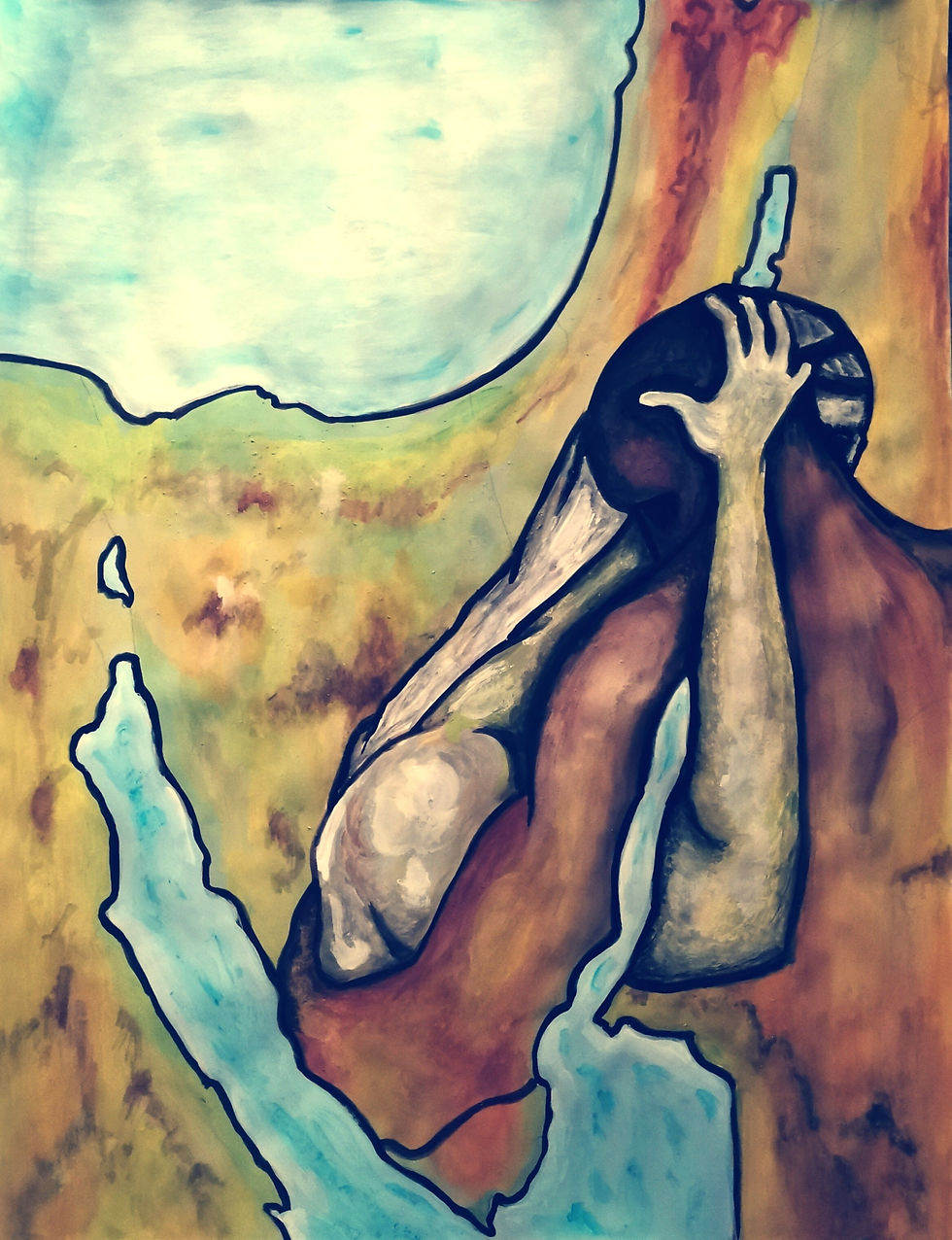
Vincenzo Cohen’s Embrace of Land and People was made in response to renewed violence in Israel and Palestine, but it does not remain at the level of reaction alone. It reaches backward, toward the Treaty of Qadeš, often regarded as the first recorded peace treaty in history, and brings that distant political memory into contact with a contemporary landscape shaped by war, dispossession, grief, and rupture. In doing so, the work asks an old and difficult question in a stripped and immediate form: what does it mean to imagine peace not as abstraction, but as a relation between bodies, cultures, lands, and histories that remain in conflict?
The painting centers on an embrace. Two male figures stand for two lands, two cultures, two religious inheritances. The gesture is simple enough to risk sentimentality, yet the work resists that collapse by grounding the embrace in historical fracture. This is not a fantasy of innocence. It is an image shaped against the fact of violence, and against the persistence of those conditions that continue to make peace appear both necessary and structurally difficult. The figures do not solve history. They hold, for one suspended moment, the possibility that political imagination might still take form through proximity rather than separation.
Cohen frames the work as a universal celebration of peace and brotherhood, but its universality is not empty. It is constructed through specific references: antiquity, territorial division, religious difference, and the enduring pressure of historical memory. The work remains open to multiple allegorical readings, and that openness matters. It prevents the image from hardening into slogan. Instead, it asks to be read as a site of tension, where symbolic reconciliation is neither naïve nor complete, but still worth staging.
What makes the work useful in the present is not that it claims neutrality. It does not. It emerges from a declared position, and from a contemporary context of war. But rather than functioning only as declaration, it turns toward an older visual task: how to make relation visible when the world is organized by partitions. In this sense, Embrace of Land and People is less a conclusion than a proposition. It suggests that peace must first be pictured as something embodied, something held between persons, before it can be imagined at the scale of nations.
This work also enters a wider field. Beginning in May 2026, it will appear in Geneva as part of the international exhibition War, something that should never be done., a collective exhibition for peace and disarmament presented at ICAM – L’Olivier with the support of Colorier l’Avenir, founded by Enrico Muratore Aprosio, who also organized the event, and ICAN. That larger context matters, because Cohen’s painting is not isolated there. It appears among works that approach war not through one single visual rhetoric, but through many: apocalyptic satire, memorial image, refugee figuration, anti-nuclear warning, damaged childhood, and symbolic aftermath. Together, these works do not produce one argument so much as a charged field of echoes.
Seen within that constellation, Embrace of Land and People functions as a threshold image. It does not depict devastation directly. Instead, it asks what image might still be possible after devastation has become ordinary. Around it, other works in the exhibition return insistently to the visible remains of war: skeletal figures, ruins, scorched cities, children under threat, memory as scar, peace as warning rather than guarantee. In that company, Cohen’s embrace becomes more difficult and more legible at once. It is not a denial of violence. It is an argument that the symbolic work of relation cannot be abandoned to violence’s total claim.
What follows here is not a catalogue in full, but a selected passage through that surrounding exhibition. These works differ in medium, tone, and geography, yet they remain bound by a shared urgency: how to picture war without surrendering either memory or the possibility of peace.
Artist Statement
Embrace of Land and People is a painting by the Italian artist Vincenzo Cohen, created in connection with the Israeli-Palestinian conflict and inspired by the Treaty of Qadeš, the first peace treaty in history. This agreement established the respective spheres of influence between the Egyptians and the Hittites after the Battle of Kadesh (1274 BCE). The work depicts two male figures, embodying two lands, two different cultures and religious traditions, embracing as a symbol of peace between the peoples. It celebrates inclusion, multiculturalism, and ethnic diversity as founding values of nations. Conceived as a universal celebration of peace and brotherhood, the painting is open to different interpretation. The two figures can be read as allegories of Semites and Hamites, Semites and Indo-Europeans, or Judeans and Sodomites.
The painting was conceived in the aftermath of the occupation of Palestine by Israeli forces. The triggering event was Hamas's attack on Israel on October 7, 2023, in response to the desecration of the Al-Aqsa Mosque and the killing of hundreds of Palestinians by the Isarelian government. Historically, since June 1967, Israel has maintained control over the Occupied Palestinian Territory (Gaza Strip, West Bank and East Jerusalem) despite the occupation being considered illegitimate and a violation of the rights of International Law by the United Nations. This is one of the bloodiest events of the Israeli-Palestinian conflict in recent decades, which has unleashed ripple effects on the Gulf nations and general financial and economic repercussions around the world. The impact was especially devastating in the Gaza Strip, where much of the population was decimated through outright ethnic cleansing (according to some historians, defined as a veritable genocide with the deaths of approximately 71,000 people). Following these events, the conflict spread exponentially, also involving the United States and Iran. The work was previously published in Exist Otherwise Literary Journal, issue 9, Oakland, CA (US), on Jenuary 2024 and will be exhibited at the Exhibition for Peace and Disarmament in Geneva starting May 6, 2026 (further details below).
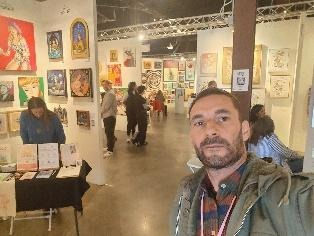
Vincenzo Cohen
is an Italian multidisciplinary social artist and writer. He earned the MFA from Fine Arts Academy and the MD in Archaeology from "La Sapienza" University in Rome. His production ranges from visual arts to writing exploring cultural and historical content as well as issues related to social and environmental justice.
Selected Works from the Geneva Exhibition
Antony Williams, Apocalyptic Evolution (2026)
Cockroaches gather in a ruined landscape beneath a nuclear cloud, thriving where human civilization has destroyed itself. Williams turns apocalypse into satire without softening its violence. The work stages survival in grotesque terms and reads as a warning about nuclear proliferation and the fragility of human order.
Beatrice Archinard, Réfugiés (1999)
Archinard’s painting of refugees moves through vulnerability without spectacle. A child at the center of the composition holds open a small but decisive interval of hope. The work locates dignity inside displacement and refuses to reduce forced movement to mere victim-image.
Connie Martinez, L’amour parmi les décombres (2026)
Inspired by a press photograph from Aleppo, Martinez’s work centers on a young boy embracing his sister after she is pulled from the rubble of a bombed home. The image is intimate, but its force lies in how quickly private tenderness is exposed as historically vulnerable. Here, care appears not beside war, but inside it.
Koffi Odoumtan, Les cendres ne parlent pas, les enfants si (2026)
Against an ashen ground recalling Hiroshima and Nagasaki, a translucent child holds an origami crane. Weapons become birds. The phrase “Never again,” repeated across languages, shifts the work from memorial image to intergenerational address. The future enters not as abstraction, but as a moral claim made by children.
Maryna Gradnova, Atrocité de la guerre. Dédié à Mykolaiv (2026)
A mound of skulls, birds, and ruins turns the page into witness. Gradnova’s ink work avoids theatricality and gains force through stark concentration. The flowing black lines suggest that trauma does not remain in the past but continues to move, to circulate, to stain perception.
Murtaza Yousofi, Sur la souche de l’espoir (2024)
A winged skeletal figure holding a skull becomes an emblem of contemporary humanity suspended between destruction and aspiration. The wounded tree stump beneath it suggests a land damaged by war and discrimination, yet still capable of renewal. The work remains allegorical, but its insistence is direct: dignity survives only through solidarity, dialogue, and the refusal of hatred.
Rais Shagiev, Swan Lake (2024)
Young dancers perform Swan Lake wearing gas masks. Shagiev draws on the political charge of this ballet in Russian cultural memory and pushes it toward catastrophe. Elegance remains, but it is contaminated by imminence. Beauty, in this image, no longer consoles. It becomes a structure under threat.
Rodrigue Legris, Until (2026)
Legris stages human fragility against organized brutality. Pale civilian figures occupy the foreground while a spectral violence gathers behind them. The image works as visual memorial, reminding the viewer that the scars of armed conflict remain lodged not only in history, but in the damaged terms through which humanity continues to see itself.
The following works are by Enrico Muratore Aprosio, founder of the Colorier l’Avenir association and organizer of the event.
Enrico Muratore Aprosio, Dystanasia (Rearm Europe) (2025)
Muratore Aprosio’s work pushes anti-militarist critique into an expressionist register. Here rearmament appears not as security, but as civilizational delirium. The painting’s visual excess is part of its argument: militarism no longer presents itself only as policy, but as atmosphere, spectacle, and mass psychic drift.
Enrico Muratore Aprosio, Hiroshima Farm (2023)
Drawing on Orwell while returning to Hiroshima, this work assembles animals over the remains of a humanity that failed to stop its war against itself and the planet. It is bitter, allegorical, and deliberately excessive. The lesson of Hiroshima, the work implies, was never fully learned.
Enrico Muratore Aprosio, After Darkness, Light (2026)
If some works in the exhibition hold the viewer inside ruin, this one turns toward endurance without innocence. The title does not erase darkness. It names survival after it. In the context of the exhibition, the work reads less as consolation than as a disciplined refusal to let catastrophe monopolize vision.
About the Exhibition
War, something that should never be done.Collective for Peace and Disarmament in GenevaICAM – L’Olivier6–30 May 20265 Rue de Fribourg 5, Geneva
The exhibition is presented in an international context marked by intensifying wars and renewed nuclear threat. It is organized with the support of Colorier l’Avenir, ICAN and ICAM – L’Olivier. ICAN refers here to the International Campaign to Abolish Nuclear Weapons, Nobel Peace Prize 2017. ICAM refers to the Institut des cultures arabes et méditerranéennes.


Comments