


The Body's Way Home | Inside Out : A Conversation with Ning Li

A Conversation with Li Ning
Valkyrie Yao: Welcome to Inside Out, a series of conversations that takes slowness as its method. History doesn't only live in books or on exhibition walls , it lives in people's choices, in their bodies, in what gets said and what doesn't. Here, we slow down with artists to feel their work, to feel the world, to feel the person. We trace how someone was formed, and we try to recover, from the inside out, the works that may still be sitting in the blind zone , the things that are difficult to name but deserve to be brought slowly into the light.
Today's guest on Inside Out is Li Ning. Li Ning, would you mind introducing yourself in a couple of sentences?
Li Ning (Lingyunyan): Hi everyone, hi Yuxin. I'm Li Ning. In the simplest terms, I'm a maker , a creator. And the second thing I'd say is that I have an intense love for artistic forms that involve the body: film, sculpture, installation, theater, performance. That's about it.

Valkyrie: I've known Li Ning for a long time, though mostly from a distance, watching quietly. Which is probably part of why he keeps drawing me in , because I'm an artist who grew out of the body myself. Then I got injured, and gradually shifted directions, and started making installation and sculpture. Sometime around the end of last year, I finally called him, and we talked for a long time. I felt an immediate recognition.
That's why we wanted to do a serious conversation with him , not just about the work, but about Li Ning as a person: his aesthetic history, his personal sense of how things have unfolded.
Let's start with a small question. This isn't an interview in the usual sense , it's a record that will stay. What's the one thing you most hope an audience takes away from you?
Li Ning: That's a real question , I've genuinely never thought about it. Give me a second. What I most hope they take away... let's talk freely, nothing too academic. I hope that maybe fifteen or twenty years from now, someone stops you on the street and says: I saw you perform once. And then they describe what you were doing. I've actually experienced this. When it happens, there's a warmth in it that's hard to explain.
As performers, we know , a theater piece at full capacity might hold two or three hundred people, sometimes fewer, and the conditions now make it even less. But sometimes you run into someone who saw a performance of yours twenty years ago, and they bring it up out of nowhere. That moment , when someone you never knew, not a friend, not a contact, stops you on the street and speaks back a specific moment of that specific evening, the physical impact of it, the warmth or the shock , as a performer, you think: that really happened. You were completely inside your own world onstage, not thinking about the audience at all, not calculating what any one person might carry away. And yet somehow what you left behind was something that served them, that gave them what we'd now call emotional resonance. That, for a performer, feels like a form of grace.
Valkyrie: That resonates deeply for me, because I think live work carries this differently. A professor once said to me: visual art and live art are fundamentally unlike. With visual art, you make something, and its life can outlast any given moment , you can return to a painting, a sculpture is still there. But live art's power is precisely its immediacy. And because memory is what it is, the experience genuinely does fade over time. That's part of it.
Li Ning: Yes.
Valkyrie: And the most moving thing, often, is when it resurfaces , when your audience, or you yourself, suddenly finds it rising up again after some time has passed. That's the greatest gift of working in live performance.
Li Ning: It's immaterial. It leaves nothing behind, not in the way sculpture does , I came from sculpture, so I know what it means to have an object remain. Maybe video remains, photography remains, but the body itself is already what the ancients called engraving on a moving boat , forever aging, forever changing state. So when you recall a live piece, what you're recalling is something that's been fermenting for years, something the memory has been quietly transforming. Which makes it more interesting, not less. It's like a chemical reaction. Like wine: the more time passes, the more concentrated the feeling becomes. You actually forget live work you've seen; but some of it you don't. Every time I talk about embodiment with my company members, I find myself returning to specific pieces I saw at a certain festival in Amsterdam , pieces that struck me with a force I still can't fully account for.
Valkyrie: Since we've arrived at this question of presence and time, I want to follow one small thread. Let's start from a turning point. Was there a moment when you noticed that your way of seeing the world had changed? A moment when your sense of who you were became suddenly more certain , or more uncertain?
Li Ning: That's happened to me in several different registers. Sometimes onstage, you might know this feeling too , the world and your body merge. The audience isn't opposite you anymore. The whole space integrates into a single whole through what your body is doing. But other times you go entirely elsewhere , you feel your own soul lift off and float to the ceiling, or migrate into the audience seats and watch yourself from out there.
That question about identity , I actually worked on a French project once where the director, who was both director and lead performer, was obsessed with exactly that: how does each person understand the question of who I am? His whole project circled it. After that experience I came back to a piece I'd done earlier that's now on our site, where I played multiple layers of myself simultaneously , a man, a woman, a spectator, a dancer, a writer composing the scene. These identities potentially created by the very writer who is himself inside the piece.
When some people saw it, they said: is this dissociation? Multiple personalities? But I don't think that's it. I think an artist , regardless of whether you'd call their state split or unified , when you look from a higher vantage, is actually an integrated whole. I've watched people who work with conditions like autism, bipolar disorder, schizophrenia , and in the act of making, they're extraordinarily unified. They've stepped outside the ordinary logic of division and reunion. From above that frame, the whole field , body, mind, audience-performance relation, self and collective , gets bound together by something, sometimes involuntarily, sometimes through a kind of mysterious force.
For myself, I'd say I believe in something like a small self and a large self , the individual, and then a larger cosmic state. That's my personal view.
Valkyrie: There's something I share with you here. When I was studying in the West, people were constantly asking: what is culture? And that question drove me back to my own , to what we came up with in China, to what I'd absorbed since childhood and never consciously examined. And one day the phrase tian ren he yi , the unity of heaven and person , arrived in me as something felt, not learned. It connected to what you're describing. There was a moment directing , watching my performers onstage still in the act, and I was simultaneously in the character, watching from outside the character, watching the audience, watching myself watching , and all of it suddenly stopped being separate units. It became one field. That's the moment I understood tian ren he yi not as a concept but as a physical fact.

Li Ning: Yes. The East-West question you raise , I live mostly in China, so I felt that resonance immediately. It explains why you're asking this.
Valkyrie: Which is exactly why I want to understand you more deeply, to understand where you came from. Let's go back a little further. Looking at the full arc of your life , you and I, sitting here across two countries, talking like this , is there a moment you can point to that changed you quietly? A moment when, whatever happened, your understanding of what was in front of you shifted completely?
Li Ning: These moments don't always happen onstage. They happen in life, in the middle of what the world does to you. There were several major shifts for me. If I trace back to the earliest one , I grew up largely in a village. I was born in 1972, the Cultural Revolution was still underway, my parents were busy, and I was raised at my grandmother's home, an ordinary rural village in the north. Which meant I was, in effect, unsupervised, in ways that life in the city with attentive parents simply didn't allow.
It was around 2017 that I went back there to film that village. Fortunately the trees, the ponds, the fields were largely unchanged. From the perspective of the people there, this was embarrassing , signs of backwardness, old buildings that needed replacing with something modern. But from my perspective, they had preserved something irreplaceable: a container for memory. I went back to a tree and found something I'd carved there as a child. I remembered I'd lost a tooth there once, so I kept that tooth, and I buried it at the root of that tree. I was in my forties by then. But it felt right , a piece of the body returning to the land where it first learned to be a body. Like a dantian, in Daoist terms: the source point, the place where all vital energy gathers. That land is my dantian. The dried riverbeds, the ponds, the dead grass of winter when I usually return , all of it holds the memory of where I came from.
And then I ran into childhood playmates , the feeling was something like what Lu Xun describes with Runtu: they had aged in the way the village ages, and I had gone into cities, into cultural work, and our paths had diverged so completely that there wasn't much to say. We stared at each other with some affection and a lot of silence. But I remembered how we used to run naked through the fields, catch locusts, trap field mice when there wasn't much else to eat.
A lot of what came later in my work , that pull toward the ground, toward the earth, toward lying on the floor or rolling in dirt , I can trace back to that. That's the source.
Then came the return to school, back to the city. I couldn't adapt. We had to wear uniforms: white shirt, red neckerchief, blue pants, canvas shoes , dozens of students in a classroom, every one of them identical, and the rules were rigid as iron. My body had already been formed differently, had already learned to move freely in open fields for seven years. Suddenly I was required to sit still for an entire morning, stand up straight when called upon. I ran away several times , ran to the mountains, to the fields, just to find some relief.
The second shift was larger. Junior high, 1985. I was thirteen. I arrived in Jinan city and heard disco music for the first time , carried by the boys my parents called delinquents, in flared trousers, with duck-tail hair and tinted glasses, lugging enormous cassette players. The whole scene I'm now making a film about: the breakdance kids.
I was terrified, but my body moved of its own accord when the music came on. That music was aggressive in a way we don't expect public sound to be now , it invaded you. But something in its abandon connected with that same abandon I'd known in the fields. My parents were frightened: you can't follow those boys. And indeed, the crackdowns of 1986 and 1987 swept a lot of them away , home dance parties raided, young people arrested, some of them shot. They were maybe five or six years older than us.
By the time of the national breakdance wave, those old forces had been completely overrun. Everyone was on the street, every neighborhood had its crew , military families, worker families, agricultural families, university kids. I joined a group called the Black Cat Squad with some guys from the military compound, kids I'd known since childhood. The logic was basically the same as what hip-hop was in America , you dance before you fight, heat the crowd, raise the energy, then the brawl follows. When breakdancing came to China from those 1984 films, it integrated perfectly. The 1980s were the one period since the beginning of the century when China was genuinely synchronized with the world, almost without seam.
Through high school I essentially stopped studying. I went from an excellent student to someone the school couldn't manage and the parents couldn't reach , my father was military, which meant his disciplinary method was a belt. But eventually even that stopped working, and everyone just despaired. I felt I'd been written off, and I didn't know what to do with myself except that I knew I loved dancing.
Somewhere in the middle of all this, I began to separate from the gang. They wanted to fight and pursue girls; I was realizing I actually loved the dancing itself. When I was on a floor and moving, I found something , a kind of being inside the body, a being recognized. In the classroom I was at the bottom; in the school assembly, when they needed someone to represent the class, they'd call me up. I found a sense of worth in that. The tension between the two of us and the third member of the crew grew until eventually we split, dramatically, in the way that kind of young friendship breaks , suddenly and completely. Then the army conscription took some of them away, university took others, and then 1989 happened, and all the dance halls were shut down overnight, under martial law. That phase of adolescence just ended.
But during those three years I'd also gotten into a fight that injured my left eye. I was taken in for surgery , the procedure required covering both eyes for about ten days.
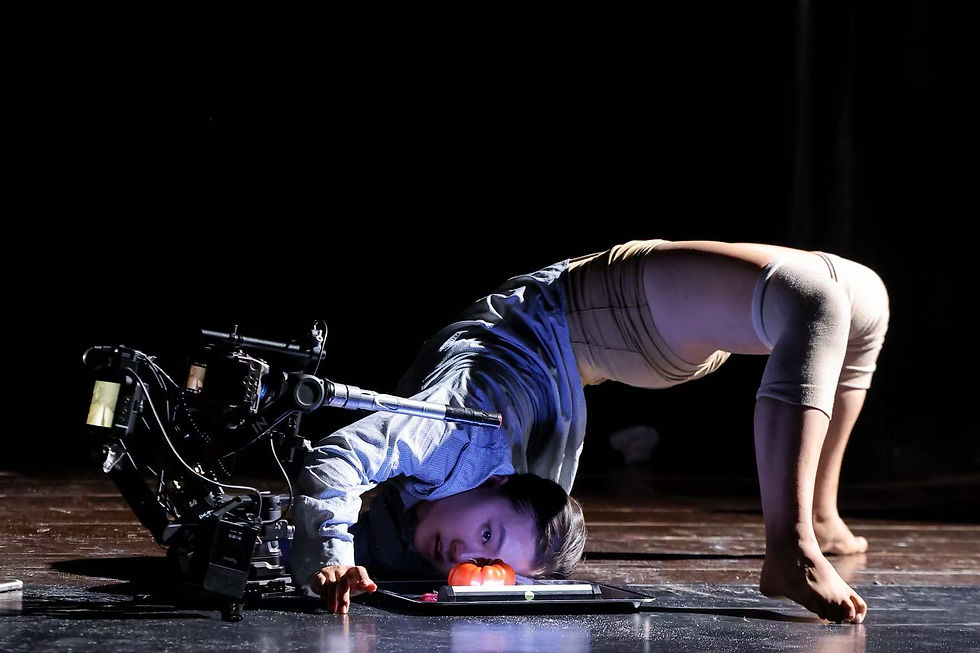
Li Ning: In that ten days of darkness, I finally went quiet. Three years of that life, and suddenly nothing. Forced into yourself. The physical pain was considerable , the surgeon cut a cross-shaped incision directly into the cornea. Even with anesthetic, each cut flooded the field red. Six cuts in total. And I could watch the scalpel descend toward the most sensitive part of me, the place most resistant to any kind of intrusion, and I couldn't escape it.
By the sixth cut, something changed. I felt as though something had shed itself. I understood that for three years I'd been running , from myself, from the fact of who I was, filling the space with everything a notoriety could provide. In that one moment, lying on the surgical table, a thought arrived, completely clear: I want to paint. I want to learn art.
Which was a kind of paradox, since my eye had just been operated on. But that's how it came. In the ten days of bandaged darkness, that thought was the only thing keeping me forward: when the gauze comes off, I want to draw the world.
When the bandages were removed, the first thing I saw was my parents' faces , their worry, their care. I realized in that moment that they loved me, that the discipline they'd imposed hadn't been the absence of love but a form of it. I told them: I want to study art. I want to paint. They were alarmed , your left eye is at 0.03 visual acuity now, how do you plan to be a painter? But I was certain. And so within three months of the surgery, I had picked up a pencil again.
I'd painted a little as a child. But returning to it now meant entering a system , plaster casts, spheres, the whole formal apparatus of Chinese arts education. Three more years. I failed the university entrance exam. Kept practicing. Finally got into the Fine Arts and Education program at Shandong Arts Institute. Sculpture major, eventually.
And during the entrance prep course, there was a girl. I'd been quietly in love with her for three years. Once I was finally admitted, I went to find her , shy about it, in the way that era required; no one was direct back then. I offered to walk her home. Things seemed to be heading somewhere good. Then my parents mentioned Rome, Florence, Michelangelo , my father's career was going well, and they were planning to send me to Italy to continue. I had become obsessed with Michelangelo at that point. The bodies in his sculpture were, to me, the most beautiful vision of what dance could be. I spent hours reprobing his figures in clay, studying anatomy, eventually sneaking into a medical school to examine skeletons after the students left.
But the transgression of spending that much time around dead bodies had consequences, or so it seemed , my father's heart began to show symptoms, my mother developed inexplicable emotional disturbances. A classmate who studied the Yi Jing told me one day: your complexion is wrong. Something is attached to you. He took me to his teacher. When I was still ten meters away, the teacher said: don't come closer. There are many things following you. He drew me a talisman.
Then my father was suddenly hospitalized , a man in good health, suddenly given a critical-condition notice. I went to him. I hadn't yet burned the talisman. I pushed through the crowd to his bedside, and he looked at me, and a single tear rolled from his eye and fell to the floor. Very clearly, very visibly. And at that moment I thought: this should be happening decades from now. I'm twenty-six. This shouldn't be the ending yet.
Something cracked open in me. Before my father's hospitalization, my girlfriend had also left , I'd locked myself in the studio for a month, working on clay, seeing no one, and when I finally came out she told me she'd moved on. I'd been carrying that grief. But in the moment my father's tear fell, something released. A lot of things I hadn't been able to let go, I let go.
Li Ning: Then New Year's Eve, that same period , almost everything happening at once. The institute was holding a costume dance. I hadn't danced at all since entering university, hadn't touched it, just lived inside the studio making sculptures. But my classmates dragged me there , apparently our class had been outclassed by another and they needed me back on the floor. I said I don't dance anymore; they physically carried me.
Then the music came on. In the moment that sound hit the room, I was suddenly back at thirteen, the first time I'd heard that music , same physical response, no controlling it. That rhythm, that disco pulse, lives somewhere in the body's oldest memory, something African, something tribal, something written into us before consciousness. When the beat arrives, you go. I started moving. The room erupted.
And somewhere in the middle of it I understood something. I'd been forcing myself to be a painter. My body hadn't agreed. It had been waiting. The body is honest; it doesn't accommodate the decisions the mind makes on its behalf. And something else happened in that dancing: the grief about the girl lifted, partially. A long absence from being recognized , because in the art school I was always catching up, always someone who'd started late, always at the margins , and suddenly the room knew what I could do. The body had made the choice.
New Year's Day. I remember it precisely: December 31st, 1994, crossing into the first minutes of 1995. From that night, something began to burn, and it hasn't stopped in thirty years.
Then three years later, my father died. 1998.
I'd been dancing in Jin Xing's company in the meantime , my father was troubled by this, a man of traditional instincts, uncomfortable with the idea of his son performing with a transgender woman. He never fully accepted it. He pushed me to take a teaching post back in Jinan after my graduation in 1997. I'd been drifting in Beijing, which is what you did then if you were serious about contemporary art , you stayed in the capital and endured it. But my father said: if you don't come back, I'll cut off our relationship as father and son. There's only one father. So I went back.
Jinan had no contemporary dance scene. This wasn't the internet era; there was no high-speed rail; getting to Beijing took eight hours. I was in a vocational school, facing seventeen-year-olds. I thought: what do I do? Then I walked around the school and found an enormous practice hall , full of dust, but mirrors still on the walls. I told my students one afternoon after a drawing lesson: would you like to dance with me? Their eyes lit up immediately. What kind of dance? Modern dance. I'll be in the hall every afternoon. They came.
These kids were only a little younger than me. We became something like a family. A lot of them were from single-parent homes, some from families that had stopped paying fees; they just showed up to dance even after they'd graduated. Parents would come looking for them and find them in the hall with me. And in trying to teach them, I realized: none of us were really trained in modern dance. So I started thinking about whether we could approach movement through the thinking of visual art rather than dance or theater technique. Not performance as its own discipline, but the visual artist's mind applied to the body. Gradually we found something that was our own, though at the time it felt more like settling , we wanted to dance, and this was how we could.
Then my father died, and I was in bed for two months. Barely eating, getting thinner in a way that frightened people. He had died in my arms; I'd watched his eyes turn upward. I felt as though his soul had pulled part of mine out with it when it left.
One day I had to go in to teach. I went to the practice hall. I looked in the mirror and didn't recognize myself , hollow, drained, not yet thirty years old. And I asked the person in the mirror: can you still dance? Can you still move? I made a few movements. Then something came back, some desire, and I started going. I danced every day for a month, in a way my students described as frenzy , like a madman. In the collisions with the floor, in the physical pain of the body striking a surface over and over, sensation returned. The numbness receded. The soul came back into the body.
And in that, dancing became something different to me than it had ever been. At thirteen it had given me back my body. At twenty-two it had told me this is where you belong. Now at twenty-six, it was as necessary as water, as food, as air. Not a source of recognition or validation anymore , a requirement for survival. A life force. If I didn't dance I would stop existing. So I stopped following anyone's technique, stopped caring about the grammar of it, and just moved , crashed, thrashed, tried to shake loose the image of my father's eyes. That was the one goal. That's when dance and body finally became, for me, genuinely one.
Valkyrie: Listening to all of that , there are really three large turning points in what you've described. If these three moments were chapters in the autobiography of a person, what would you call each of them?

Li Ning: I've never summarized it like this before. The first one, at thirteen: I found my body back. After seven years inside the school system, my body had been disappearing. The uniforms, the stillness required, the disappearance of movement as a way of being in the world. The music and the dancing gave the body back to me.
The second, after the dance at university: I belong to dance. I'd been trying to make myself into a painter. But the body hadn't agreed. It was waiting.
The third, after my father's death: dance is necessary. Not a venue for recognition, not a source of identity , a life requirement. Something without which the organism cannot continue.
I think everyone who loves dance or movement has their own version of these stages. The specifics differ, but the structure probably resonates. You come to love something because it has carried you through something that couldn't have been carried any other way.
Valkyrie: There's a term in Western scholarship , embodiment , that tries to get at exactly this. The way a practice, over time, becomes part of the body's memory, part of its way of perceiving, part of a worldview. A way of knowing the world that operates through movement rather than through reading or watching. When your body starts moving, you're not learning about the world, you're directly inhabiting it, digesting it. I think that's what everyone working in physical practice shares, whether in dance or theater. What brings us naturally to work. This next section of our conversation we call Blind Zone , those places in a piece of work that exist in relation but go unnoticed. We're not interested in the author, the biography, the context. We're interested only in the work itself. I'm going to share a piece with you now. We watch it together, and then we talk. Neither of us explains anything , we just see what's there.
Let me share my screen.
(Both watch the work in silence.)
Valkyrie: We're back. The piece is called Taking Root.
Li Ning: Right.
Valkyrie: What did your body do during that? We've been talking a lot about physical response , I'm curious what happened in yours.
Li Ning: Can I be completely honest? I'm worried the creator might hear this and feel uncomfortable.
Valkyrie: Of course , honest exchange between artists is the only thing that has any value.
Li Ning: Then honestly: this kind of performance, this approach to the body , it didn't touch me. While I was watching, a few questions kept surfacing. The main one was: why couldn't this have been taken into a real space? Outside, or at least somewhere that wasn't a classroom?
The performers are clearly committed. The choreography is considered, the staging is careful, the props are used well, and the ending is genuinely strong. But through the whole piece, I kept being pulled out by what was in the frame: air conditioning units, windows, the equipment visible at the edge of the shot. The male dancer turns toward the evening light and an air conditioner unit drifts across the frame in front of him. I kept losing the work to the room. If this piece were on a riverbank, or in a field, my engagement would have been total. I'd say that without reservation.
The classroom carries a rehearsal quality with it automatically. And the performers , they're genuinely invested, I don't question that , but they're working in a register that's very codified. Every gesture, every glance, every shift of weight is carrying a symbol. You get a sense of language being deployed. Emotion communicated through signs. And that puts a layer between me and what's happening , not because the performers aren't committed, but because the mode is one of symbolic transaction, and symbolic transaction always holds you slightly at arm's length.
What I want, as a viewer, is to encounter a human body and its actual state of life, and for that encounter to arrest me before I can categorize it. I shouldn't be able to identify this as a contemporary folk dance piece. I should only be able to say: there is a person there, and something is happening. The form, the genre, the type , those should be irrelevant, or invisible. When I can name the taxonomy before I'm arrested by the life, the piece hasn't fully gotten to where it's trying to go.
Some people , people who don't dance at all , can achieve this more readily than trained performers, precisely because they have no vocabulary of codified gesture. Their body just exists, and you watch its actual state, its actual force. Of course many performance artists fall into the same trap eventually, reaching for symbolic gesture. But at least initially there's no ready path.
I should be clear: this is purely my own response. It isn't a general verdict.
Valkyrie: No , I think this kind of directness is exactly what we're here for. And the observation about the environment is fair. I want to be honest that we may have come to this piece as film directors, looking for a complete world , the right setting, the coherent logic of where the story takes place. That's a different expectation than the creator may have had when shooting it.
Li Ning: I don't think it was shot as documentation, though. Documentation has its own camera grammar. This is clearly cinematic work , professional operators, considered framing, a real intention to make a screen piece. It just didn't take the environment seriously. There's a breath missing. The piece could have been whole. It's close. It just needs to be finished, taken outside, placed in the world it's trying to speak about. That's a real loss.
I think of Wu Wenguang and Wen Hui , when they responded to my early work, they were merciless. I'm grateful for that. Because they were honest, I could keep going. If they'd been polite, I might have prolonged a wrong direction.
Valkyrie: I understand that. Where was the most honest moment in the piece? If you had to point to one second?
Li Ning: The ending. When he looks back and the bodies have transformed into something growing , bamboo, or some version of living upward force. That image is the one that stays. It earns its place.
And the camerawork throughout is really good. Which makes the indoor setting more frustrating, not less. Take it to a riverbank and you have something remarkable.
Valkyrie: Now I want to turn to your own work. I've been sitting with it since you shared it with me. I want to look at Unfinished Two the same way , without the author's intention, without the frame we bring from knowing who made it. If you had to describe that piece as a kind of weather, what weather comes up in the memory?

Li Ning: You mean that one set in the abandoned buildings, yes , the unfinished towers, the ones that have just been sitting incomplete for years. Right. That piece was made with a dancer from Shanghai named Nu, an excellent mover who was also working across disciplines at the time, and her husband Tom, an American sound artist of German background. The three of us were the core of the piece.
They wanted to move from stage work into something for the screen. I said I had two buildings in Jinan , unfinished towers that had been sitting empty for years. When they saw them, they immediately understood: the scale, the ruin of it, the palace-like quality.
For the weather , I think of it as two distinct climates now, because the two buildings gave us two entirely different atmospheres. The first was next to Daming Lake, surrounded by water on all sides, sealed in damp, dim, a fungal coldness that had nothing to do with Jinan's usual dry heat. The second was up in the hills, all exposed stone and parched air. Two buildings, two weathers, and we weren't supposed to be in either of them , we were sneaking in to shoot.
The encounter with the security guard, Old Chen, became the pivot of the whole thing. We'd just done an exterior shot , a German-American, naked in the frame , and a police officer arrived with a leashed German shepherd. Documentation, interrogation, all of it. After the drama settled, I went to Old Chen with two bottles of liquor and a couple cartons of cigarettes. He was being paid 600 yuan a month to watch the buildings. I offered him a thousand to be in the piece. He agreed, with one condition: he would not be naked. I respected that, and then gradually negotiated , could he take off his shirt? , and he eventually agreed to everything except the trousers. Which was honestly funnier and stranger than nudity would have been. He became one of the most important presences in the whole film.
Valkyrie: Which brings me to something I've been wanting to ask for a long time. The question of nudity in your work. You've been making work in China, and in China nudity , whether as a term in public discourse or as an element in an artwork , has always carried a specific charge. When did you first bring nakedness into a piece? Was there hesitation? And then , across the later work where it appears extensively , when you use it, is it because the work genuinely requires it, or because it has become a signature you keep reaching for?
Li Ning: First, the historical frame: the prohibition you're describing mostly applies after 2013. From the early 1990s through roughly 2010, Chinese contemporary art was in a period of enormous expansion, and nudity was genuinely widespread. Yuanmingyuan Artists' Village, the East Village, Songzhuang , in Beijing and elsewhere, it was common across painting, installation, live work. Any serious exhibition had bodies in it, covered and uncovered. It was the norm in that world. Dance and theater were probably more conservative than visual art in this respect, but within the wider contemporary art context, I was not unusual.
What first moved me to use it was something I witnessed rather than something I planned. Some artist friends , I'll mention Gao Brothers, though one of them has since been arrested , were using day laborers as performers: men from the construction class, physically built from heavy work, gathered on a rooftop, embracing each other. They began fully clothed. As I watched through a camera, they started removing their clothes piece by piece. And when the last social markers fell away , the clothes that coded their work, their class, their function , something became visible that I can only describe as the body's own subjecthood. What remained was the being of the body, unmediated.
The only social sign that persisted was the haircut. The cultural shaping that was visible in the hair. Later, when some of them shaved their heads, that too disappeared, and then you were genuinely before the body as material.
This connected immediately to everything I'd trained in as a sculptor , the partial forms in Michelangelo, the anatomical drawings, the way the form itself becomes the subject when the identity has been stripped. And I started thinking about how the body's surface carries its biography: the musculature of someone who does physical labor, the posture of someone who sits at a desk, the belly of someone who drinks , all of it there, inscribed. If a trained performer can bring that fixed inscription back into movement, you have something that bridges sculptural form and live action perfectly. That was the original logic.
Later, I moved away from it. Partially because I realized that full nudity sometimes pulls the audience toward the body's privacy, toward a reading that competes with the work. The compromise I found was a flesh-toned brief , it gets through institutional review, it survives the scrutiny that became stricter after 2013, and it doesn't impose the additional layer of nakedness-as-subject. The body-ness remains. And I'll be honest: in specific conditions, with specific audiences, nudity is still the right choice. But the preoccupation with it has become, for me, a smaller consideration. The larger questions in the work are more interesting.
Valkyrie: That connects to the other thing I've been wondering about. Does the censorship system , as it has tightened over the years , extract a cost from you? Is there something in your original artistic ambition that has been quietly surrendered?
Li Ning: There has been some of that. Wim Vandekeybus is the closest example I can give , he's never performed in mainland China because he won't give up nudity in his work. He plays Hong Kong; we go to Hong Kong to see him. And in his work the nakedness is genuine , it never reads as spectacle or provocation, it's simply necessary to what the piece is doing. The kind of misreading that might happen with a Chinese mainland audience simply doesn't apply to how he uses the body.
After 2013, I began to exercise some self-censorship , deciding that if I wanted a piece to be seen, I needed to account for what the room would bear. In natural settings, like the Aranya arts context, or outdoors in specific environments, the body's relationship to landscape reads cleanly. In a festival context , Wuzhen, say , you have to calculate.
But I want to say honestly: since about 2010, this has become a secondary consideration in the work. What I'm thinking about now is whether the work itself is sound , structurally, conceptually, in terms of what it's actually doing. Whether someone is wearing something or not has become a small decision inside a much larger one. That's the shift.
Valkyrie: If Unfinished Two could leave only one sentence for the future, what would it be?
Li Ning: Something like what I wrote in the original notes for the piece: these buildings that will never be completed are like our own bodies. That would be the sentence. A permanent state of incompletion. These towers that will never be finished , like the body.
Valkyrie: And stepping back from the work , what do you want to leave for the future? Not for now, but for what comes after?
Li Ning: The work, I think. If the body is a blade, then the work is the mark the blade makes. The body disappears, but the mark remains. And the mark might live in the way I described earlier , in someone's memory, twenty years from now, of a specific moment in a specific performance. Or it might live in a film, an image piece. I'm genuinely grateful that a platform like yours makes this possible , the way you're archiving work is a form of museum that can last. The work stays accessible. You can always return to it.
Valkyrie: That's exactly why we started this , as a form of archive, a place that doesn't disappear. The work remains available, returnable. Before we close, let's make this a little more particular: if someone hears this episode and wants to understand you, and they can only keep one sentence , what do you hope it is?
Li Ning: I've said a lot, so let them choose what resonates with them. But if I'm choosing , maybe: the body still belongs to dance. I'm anti-dance, in a sense, in the work I make now. But I know very clearly that it still belongs. The body must move. That's it.
Valkyrie: Then last question: give this episode a title. This conversation about you as a person, and about your work , what do you call it?
Li Ning: The Body's Way Home. Li Ning, Part One. If we get the chance to continue, we keep counting.
Valkyrie: The Body's Way Home it is. We've covered a great deal today , and I have twice as many questions still waiting. Which means we have every reason to do this again. I've been wanting this kind of conversation with you for a long time, and I'm grateful it finally happened. It's late where you are , let's stop here, and I look forward to the next time.
Li Ning: Same here. Thank you, Yuxin. Truly. We'll keep talking. Rest well , it's late. Goodnight.
Valkyrie: Goodnight. We'll send you the materials once we've put them together, so you can look through before we publish.
Li Ning: Perfect. Take care of yourself. Goodnight, everyone. See you next time.
Long Form Coversation
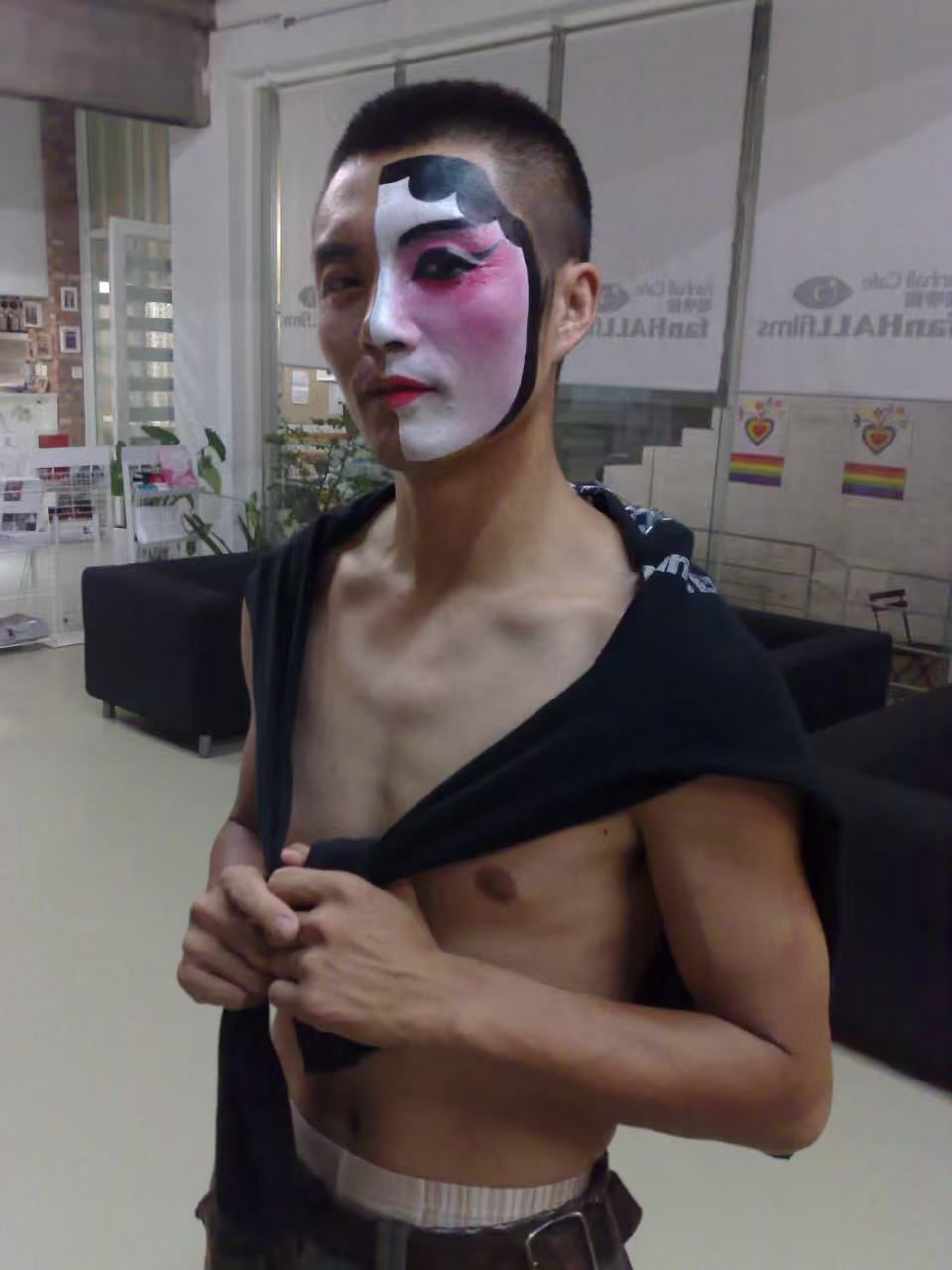
Li Ning (together with his collective “Lingyun Flame”) was born in 1972 in Jinan, Shandong, China. Experimental theater and film director, Body-based performance artist, Director of photography, Editor, and Curator of site-specific projects.
He works across multiple roles as an experimental theater and film director, body-based performance artist, director of photography, editor, and curator of site-specific projects.
Li graduated from the Fine Arts Education Department of Shandong University of Arts, with additional studies in sculpture.
In 1997, he founded the “Lingyun Flame Physical Guerrilla Group,” and for many years has carried out cutting-edge explorations in physical theater and film.
As a theater artist, he has been invited to perform, screen work, and give talks at festivals such as JULIDANS in Amsterdam, the CULTURESCAPES Festival in Switzerland, and others. He has participated in devising work with the French situational theater company Ilimitrof Company, and has led the Lingyun Flame Physical Guerrilla Group on touring performances at the Avignon Festival, the Aurillac Festival of Street Arts, the Gent Arts Festival in Belgium, the Tokyo Festival, the Wuzhen Theatre Festival, the New York “Innovative China” Festival, the Beijing International Youth Theater Festival, the Shenzhen–Hong Kong Bi-City Biennale of Urbanism/Architecture, the Dashanzi Arts Festival in Beijing, and many other events.
As a contemporary practitioner of body-based education, he emphasizes the development and systematization of training methods. Drawing on his own background in visual art, he created the performance and training course “Body Sketching and Re-Sketching.” For many years he has actively carried out workshops in universities and communities across different regions, building a bridge between ordinary people and contemporary art, and helping to enhance participants’ physical–mental creativity and aesthetic awareness.
He has been invited by institutions such as New York University (NYU), the Central Academy of Fine Arts (CAFA), Hubei Institute of Fine Arts, China Academy of Art, Shandong University, and others to give lectures or teach longer-term courses, and has served as artistic advisor for graduation presentations in fashion design and new media.
As an image-maker, he has been selected for and awarded at multiple international film festivals. Representative works such as TAPE and Untitled-3 have been collected by university libraries, art museums, and other museums in Europe and North America. He has received support from multiple foundations to complete his films, including the DOEN Foundation in the Netherlands (which supported Li Ning for three consecutive years in 2006, 2007, and 2008), the EU cultural project “Chin-A-Moves,” as well as the Indie Cinema Fund for Chinese independent film, the Goethe-Institut, and others.
As a curator, he has initiated and run platforms for rural and community-based art such as the Fangyu ART Festival in Jinan, the Laiwu International Factory Theatre Festival, and the Qichangcheng Rural Arts Festival.
His core belief is: “Space is not merely a stage on which people perform. It is itself a work.”
His ideal is: “To let theater once again become a form of public entertainment in everyday life.”
He has been called “the initiator of public theater.”
Inside Out is a slow, in-depth conversation series produced by ELSEHERE Global, and published through STRATUM. This conversation has been transcribed and translated from the original Mandarin recording.



Comments