


Toward a New Humanism: Digital Art and Activism in the Age of Technology | Inside Out: A Conversation with Enrico Dedin

Toward a New Humanism: Digital Art and Activism in the Age of Technology
A Conversation with Enrico Dedin
Enrico Dedin works at the intersection of digital culture, image-making, and critical reflection on the present. In his practice, the smartphone, the archive, found footage, symbolic collage, and AI are not simply subjects or tools. They are symptoms, infrastructures, and mirrors through which contemporary life reveals its rituals, dependencies, and cognitive transformations. What follows is an edited text-based conversation drawn from his written responses, focusing on technology, myth, critique, and the cultural conditions shaping perception today.
ELSEHERE: Looking back, was there an early experience, environment, or way of observing people that shaped your anthropological gaze toward both online and offline life?
Enrico Dedin: Looking back, the kind of experience you describe came through my discovery of philosophy during adolescence. In those years, my engagement with the thought of Friedrich Nietzsche, Zygmunt Bauman, Umberto Galimberti, Günther Anders, and Hans Jonas shaped my emerging anthropological perspective on the human condition we were living through, and would continue to live through, both as individuals and as a society.
ELSEHERE: Is there something from that earlier period that still operates in your work now, not as subject matter, but as method, tension, or way of reading contemporary behavior?
Enrico Dedin: I truly believe so, though not so much on a stylistic or formal level as in terms of tension and in the way of interpreting the present in relation to technological development and the role of artistic and humanistic disciplines. Recently, looking back and observing the direction contemporary society is taking, I’ve realized that many of the reflections I developed at that time, when almost no one was talking about these issues, were remarkably forward-thinking.
For example, I had already begun a critique of the ideology of Transhumanism and Posthumanism, developed the literary manifesto of Meta-Luddism, and spoke of concepts such as the “anthropic party,” “claustrophilia,” and others that, in hindsight, now seem even more relevant, and almost prophetic, in a world increasingly cohabited by artificial intelligences.
ELSEHERE: You describe your work as examining the impact of digital technologies on our experience and perception of reality. What, for you, is the difference between documenting that condition and building an image-language adequate to it?
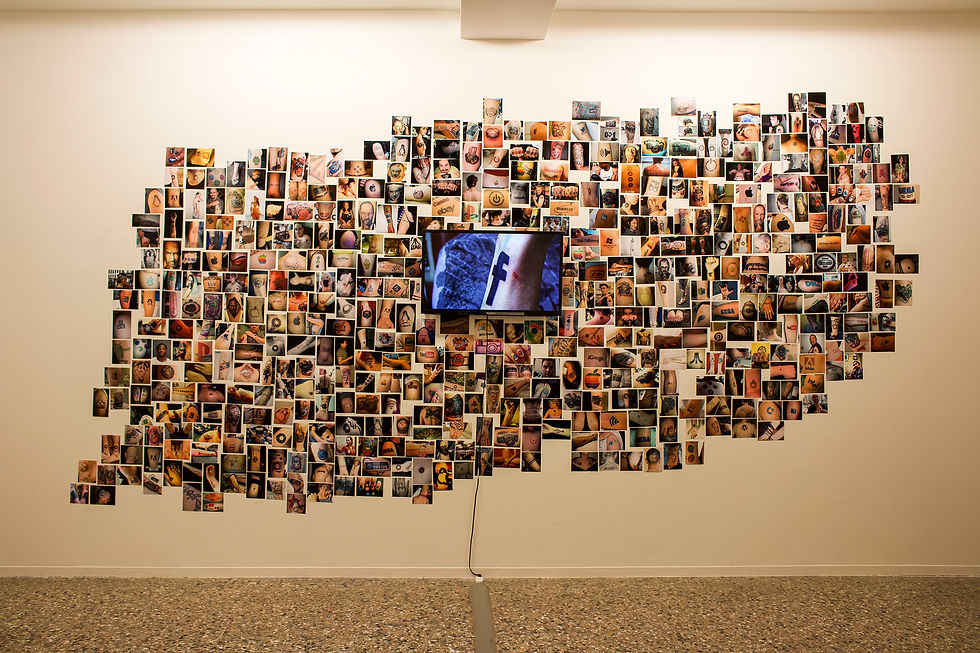
Enrico Dedin: Documenting this condition means, for me, being almost an archaeologist of the present, or a historian of the future, even before being an artist. In this sense, documentation becomes true documentation in its own right. This is why I often employ the modus operandi of appropriationism and found footage, remaining within an audiovisual grammar. Works rooted in the concept of the archive, such as Digital Tribalism and NR Code, are examples of this.
In other works, especially video art pieces like Socialhenge, The Photo Hunters, Alla Luna, and Nature Training Center, I integrate elements of found footage from social media with audiovisual compositions that are more intentionally constructed through a kind of digital collage adopted as a dominant practice. In these cases, I actively build visual languages that reflect our current social and individual condition, dissolving the boundary between pure documentation and the creation of a language-representation.

More recently, however, I have also begun to keep these two aspects more separate, creating almost parallel worlds that move away from documentation and draw closer to a new form of emblematic and symbolic storytelling. The works I’m currently developing are moving precisely in this direction.
ELSEHERE: In Mirrorphones, why did this subject need to become a mythology of the present, rather than a straightforward critique of smartphone culture?
Enrico Dedin: Because criticism that operates first on a symbolic level, at the roots of the myths, the “fables” underlying certain postmodern values, is often more effective than direct, unfiltered denunciation. That mythology, which is ironically attacked and decontextualized in Mirrorphones, is expressed, for example, through emblematic phrases present in the works, such as Steve Jobs’s “Stay hungry, stay foolish,” or the alteration of the motto “In God We Trust,” printed on U.S. dollars, into the new “In Tech We Trust,” often overturning its original positive meaning.
ELSEHERE: You write that the series critiques an ecosystem from within, merging artistic gesture and AI. What does it mean to you to work critically from inside the systems that are already shaping perception, rather than from an imagined outside?
Enrico Dedin: Many years ago, a person who was instrumental in my artistic and authorial development said, very wisely, that in order to critique a system, you have to be inside it. I share this view. Doing so from the outside is not the same as engaging critically from within, with a deep understanding of its technical and theoretical logics.
In any case, I do not believe in the idea of critical action from the outside. It would be ineffective, almost a form of surrender, like isolating oneself in an ivory tower. To genuinely attempt to make a concrete and meaningful contribution to one’s present, I believe it is necessary to inhabit it from within and embody its contradictions.


ELSEHERE: The work suggests a regressive form of progress: connecting while isolating, informing while confusing. Do you see this as a technological problem, a social problem, a spiritual problem, or a crisis of attention more broadly?
Enrico Dedin: I fundamentally see it as a cultural problem. It stems precisely from the absence of an ethic of prevention and a far-sighted humanistic and philosophical approach applied where it would be needed most, at the highest levels of the tech world. Unfortunately, we live in a world where the primary principle and ultimate goal seem to be business at any cost, even at the expense of people’s well-being, society, and the planet.
One need only think of algorithms designed to keep us glued to platforms through mechanisms similar to gambling addiction, steadily eroding our attention and concentration; browsers programmed to polarize and show us only what an algorithm believes might, or should, interest us; chatbots trained to validate us; and so on. In practice, we are living under a kind of brand imperialism, and our minds are the colonized territories.
ELSEHERE: At this stage of your life and work, what feels most urgent to keep pursuing in your practice?
Enrico Dedin: At this stage, I’m seeking to raise awareness and encourage a broader understanding of how contemporary art can find fertile ground beyond the traditional spaces of museums and galleries, by promoting a new model of branding and enterprise capable of integrating art and the humanities into its core business.
In light of developments in automation and artificial intelligence, I believe it is important to begin rethinking corporate realities not merely as places of economic and monetary production, but as cultural actors whose impact on people and territory also extends to psychological, physical, and social well-being.
At this point in my journey, I am therefore combining this line of research with my artistic practice, to the extent that I have coined a new term, and with it, a new role, to define it: “Artivator,” a neologism born from the fusion of “Art” and “Activator.”

ELSEHERE: When people encounter your work, what do you hope stays with them after the immediate impact of the image, or the critique, has passed?
Enrico Dedin: I hope it can leave a trace, something that can settle in the spirit or in the memory, like a file saved in one’s favorites, revisited from time to time in order to feel a little more human.
ELSEHERE: If this feature had a title, what would you want it to be called?
Enrico Dedin: Toward a New Humanism: Digital Art and Activism in the Age of Technology.

Enrico Dedin
Enrico Dedin, born in Treviso in 1996, is a media artist and art director based in Venice. His video works are included in the catalog of Heure Exquise!, distributor of the audiovisual collections of the Musée du Louvre and the Musée d’Orsay, and have also appeared on international platforms including Harddiskmuseum, Exibart TV, and nextmuseum.io of NRW-Forum Düsseldorf. He has participated in a wide range of exhibitions and events, including the 16th Videoart Yearbook, Collettiva Giovani Artisti at Fondazione Bevilacqua La Masa, and The Wrong. His work was featured in Viviana Vannucci’s book L’arte del XXI secolo. Temi, linguaggi, artisti. He is also the author of the literary manifesto of Metaluddism and works professionally as an art director in multimedia communication.
About Inside Out
Inside Out is ELSEHERE’s long-form conversation series, published through STRATUM. It begins from the belief that before artists are understood through category, institution, or medium, they must also be encountered through the deeper structures that shape a practice over time: memory, method, contradiction, relation, and the conditions of life pressing from within the work. This conversation with Enrico Dedin has been edited from his written responses for publication.



Comments