


Engineering the Intuition | Inside-Out: A Conversation with Rui Yang

Updated: Jul 19
Rui Yang’s work lives in the fascinating friction between razor-sharp engineering logic and fluid artistic critique. As a New York-based multidisciplinary artist and full-time commercial CG generalist, Yang utilizes everything from high-end CGI and animation to custom AI workflows to dismantle how technology reshapes our modern world. In this text-based conversation, we trace the roots of his practice and his double life balancing corporate CG production with gallery fine art.
Before the Work Had a Name
Formation, memory, early perception, and what still operates beneath the work
ELSEHERE: Before you had a name for what you were doing, was there an earlier way you understood yourself in relation to images, systems, or constructed realities?
Rui Yang: Yes. I remember when I was little, I would mimic the demeanor of the cartoon characters I saw on TV. I didn't realize it at the time, but it felt entirely natural—less like a child watching a cartoon, and more like the characters coming alive to share my body. Looking back, I now recognize that those characters were never just clumsy individuals; they were products of a constructed reality, designed by an entire production team that carefully calculated their personas, scripts, and behaviors. By impersonating them, I was allowing an engineered reality to project onto my perception, all while believing it was my own choice. It wasn’t sinister, but it is incredibly intriguing to look back on.
ELSEHERE: You began in engineering before shifting into creative practice. Looking back now, what did that earlier way of thinking teach you that still operates in your work, not as biography, but as structure, instinct, or method?
Rui Yang: I was expected to become an engineer or programmer because of my family. It made sense to them because art is often deemed unprofitable, and they didn’t want me to become a starving artist. But because of that, I was always encouraged to be rational, logical, and analytical.
Coming from that background, when I shifted into the creative field, I tended to do a lot of research and list a bunch of bullet points. I’d spend a long time debating with myself, making sure the ideas didn't contradict each other. I’d bring up a lot of “what-ifs” for the possibilities of the final work, then slowly and carefully eliminate the ones that I felt didn’t make sense. In short, it is easy for me to find a motif for creation out of intuition, but I usually rely on a lot of research and debate to ensure the artistic thesis is completely airtight.
Practice, Research, Method
The center of the practice, method, form, and how research enters the work
ELSEHERE: Across animation, CGI, AI workflows, video, 3D printing, installation, and moving image, what is the question, pressure, or condition that most consistently organizes your practice?
Rui Yang: My practice revolves around the question of what we actually want if we have the capability to recreate reality. New media tools—from video, 3D, and CGI to AI—all claim to enable us to build alternative realities; their ultimate promise is 'whatever you want' or 'limitless possibilities.' While I don’t doubt human creativity and imagination, I am far more interested in exploring the correlation between the imagery we create and the underlying motivations behind those choices. If all possibilities are available to us, why is it that certain combinations of pixels appeal to people so much more than others?
ELSEHERE: You work both in high-level commercial CG production and in fine art. What does that double position allow you to see about image-making now that someone working only inside one of those worlds might miss?
Rui Yang: I feel so lucky to be able to see the image-making world from both sides because it gives me a very nuanced perspective. Though there are overlaps in the tools I use for both sides, the mentality and lens are totally different. From the commercial CG production side, the goal is to use every tool and technique possible to make the highest quality imagery. It is intended to convince consumers or audiences to believe in a designed narrative. The work is usually collaborative, so it is fun to work with other artists, but it can be limiting for my own expression. The labor, media, and politics behind the production are usually overlooked.
Conversely, in fine art, being profitable is usually not the priority. Concept, criticality, and ideas are more important. Fine artists who operate solely in the gallery world often lack a firsthand understanding of the corporate frameworks and commercial systems that actively shape contemporary society.
AI, Image Production, and Nonhuman Authorship
Machine co-authorship, image ontology, and the conditions under which AI sees
ELSEHERE: You said one of your strongest interests is AI co-authorship and image production. In your own terms, what does “co-authorship” actually mean here? Where does the machine stop being a tool and begin to act as a participant in the work?
Rui Yang: Co-authorship means I don't have full control of the final work. I don't execute 100% of the work, but design an apparatus that allows the machine to finish part of it. I believe the key for the artist to have AI as a participant instead of a tool is to design a custom workflow that reveals some AI-unique features in the work or uses those features critically. It's not interesting to me to use AI for decorative purposes — like generating a pink dolphin that looks fancy. I have a criterion for myself: if I only use AI as a highly efficient, low-cost illustrator or graphic designer, I am only using it as a tool.

ELSEHERE: In Sun Deity, the AI model is trained on images of historic sun gods from different civilizations, yet it treats them only as images, or as code, without cultural or theological context. What did that indifference reveal to you?
Rui Yang: Sun Deity reveals the fact that beliefs are always heavily image-based. I got the idea for the project when I visited The Metropolitan Museum of Art. At the museum, sacred objects across cultures are carefully classified, placed in an environment for people to observe and appreciate. This setup strips them of their original sacredness — not in a bad way, but it is not designed for worship or prayer. Instead, visitors are expected to see those sacred objects through the lens of history, archaeology, and science. They are treated as cultural heritage and historical antiquity, rather than as symbols of any ongoing discourse. In this sense, there is already a sense of indifference in the museum setup.
In Sun Deity, I just take one step further by treating those historical antiquities only as images and feeding them to the AI model. The tricky part of Sun Deity is, if you only look at the morphing AI area, it definitely feels indifferent. However, there is also a CGI golden monstrance to "hold" the AI sun god, signifying ritual and divinity. I try to create a tension to imply that, while beliefs are heavily image-based, there is much more than just images about belief. There are rituals, stories, practices, and much more.
Human Layer: Life, Time, What Remains
Continuation, life experience, time, residue, and what the work leaves behind
ELSEHERE: At this stage of your life and work, what feels most urgent for you to keep pursuing, even if it remains difficult to define clearly?
Rui Yang: In the past couple of years I've tried different media and workflows. I've already mastered the skills in CGI but my fine art career is still at an early stage. I tried to stay away from a more representational visual style because I wanted to compartmentalize my CG/VFX side and my fine art side. Maybe that mentality is a constraint. I feel it's most urgent for me to narrow down my practice into something that's most comfortable for making my points.
Rui Yang's Work


Sun Deity, 2:00 single-channel video, 2026
Exhibition: Digital Graffiti at Alys Beach, FL, 2026
About Rui Yang
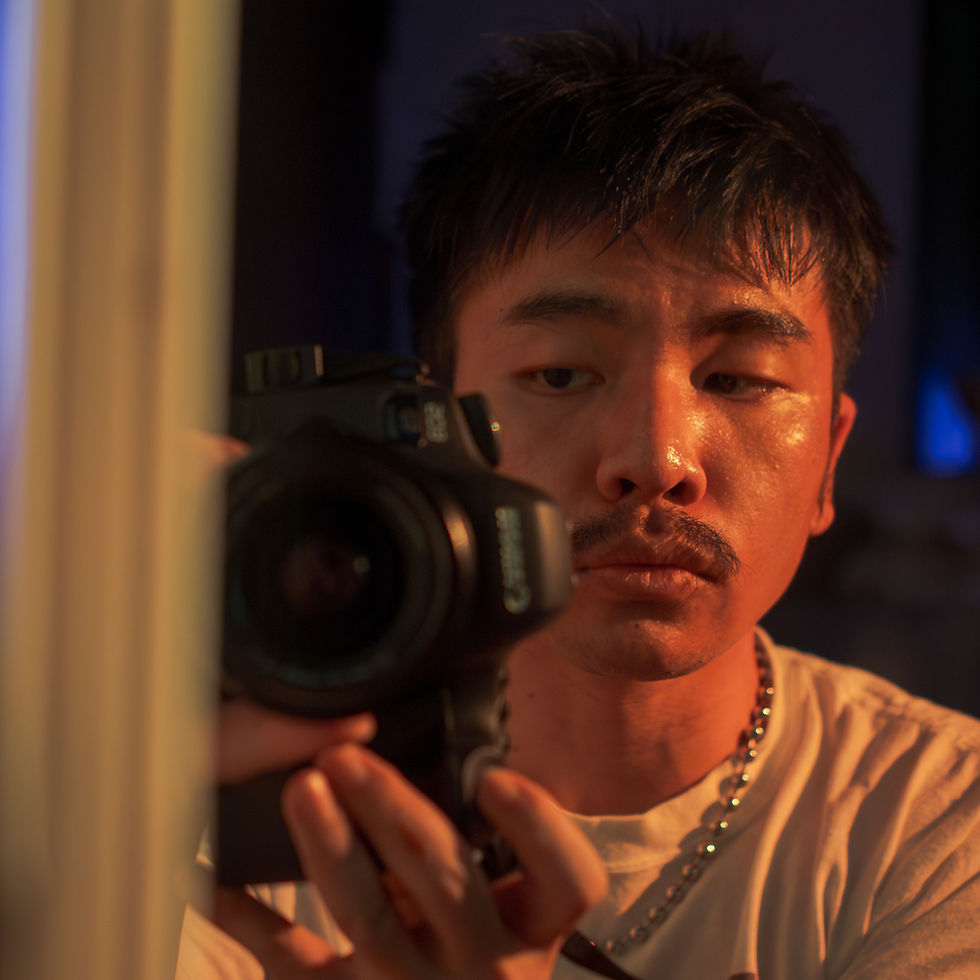
Rui Yang is a multidisciplinary artist and CG generalist based in New York. Born and raised in Kunming, China, he initially trained in engineering before shifting toward creative practice, driven by a deep fascination with visual storytelling and contemporary media critique. As a full-time CG artist in the video production industry, Rui has contributed to major Netflix productions and high-profile commercial campaigns. In parallel, his personal practice has emerged as a distinct voice in the new media art scene, exploring post-digital identity, cultural hybridity, and the reimagining of contemporary mythologies.
Artist Statement
As a Chinese-born, Brooklyn-based multidisciplinary artist, I work across the fluid intersections of animation, CGI, video, 3D printing, installation, and AI workflows. My practice explores how cultural memory is translated, flattened, and reinvented through the lens of modern technology and digital media. Employing a critical yet playful sensibility, I pull from my own inter-cultural experiences, historical mythologies, pop culture, and social commentary—appropriating and twisting these elements with deliberate intention to repurpose them into something distinctly my own. Through the deliberate remixing of diverse media and cultural references, I seek to recontextualize the familiar, challenge how we consume imagery, and open new pathways for collective meaning.
About Inside Out
Inside Out is ELSEHERE’s long-form conversation series, published through STRATUM. It begins from the belief that before artists are understood through category, institution, or medium, they must also be encountered through the deeper structures that shape a practice over time: memory, method, contradiction, relation, and the conditions of life pressing from within the work. This conversation with Rui Yang has been edited from his written responses for publication.
Edited by Yuyang Hu


Comments